Introduction
Okay, this is the foundation chapter. Get this one solid and half of chemistry stops being scary. It's basically two questions: what is an atom made of, and how do atoms stick together?
An atom = a tiny nucleus (protons + neutrons) with electrons buzzing around in shells. And atoms join in exactly three ways: they give/take electrons (ionic), they share them (covalent), or they pool them (metallic). The exam's favourite move: use the structure to explain a property (melting point, conducting, hardness). This is your fast refresh, not the full textbook: one key idea per section, one worked example, and the exact thing the marker wants. Let's go. ⚛️
Elements, Compounds and MixturesE2.1
An element is one type of atom (iron, oxygen). A compound is different elements chemically joined in a fixed ratio, with brand-new properties (water, CuO). A mixture is stuff that's not joined, in any ratio, that you can split with physical tricks (filtering, a magnet) — like air. The magic question is always: are the bits chemically joined? Joined = compound. Not joined = mixture.
> 🔑 Key idea: The deciding word is "chemically". Chemically joined → compound. Separated physically → mixture. One type of atom → element. 🧩
Worked Example: Spot the TypeE2.1
Problem True or false: (a) in an element all atoms are the same type; (b) a compound has different atoms chemically joined; (c) a mixture can be separated physically.
Step 1 Element = one type of atom ✓. Compound = joined chemically ✓. Mixture = not joined, split physically ✓.
Step 2 All three are correct. The trap options swap clauses (like saying a compound splits physically — nope).
Underline "chemically" and the answer pops out. ✅
Atomic StructureE2.2
An atom = protons (charge +1, mass 1) and neutrons (0, mass 1) in the nucleus, plus electrons (−1, basically no mass) in shells. Two numbers run everything: proton number $Z$ (= protons = electrons if neutral) and nucleon number $A$ (= protons + neutrons). So neutrons = $A − Z$. Electrons fill shells 2, 8, 8, and that tells you the Periodic Table spot: period = number of shells, group = number of outer electrons.
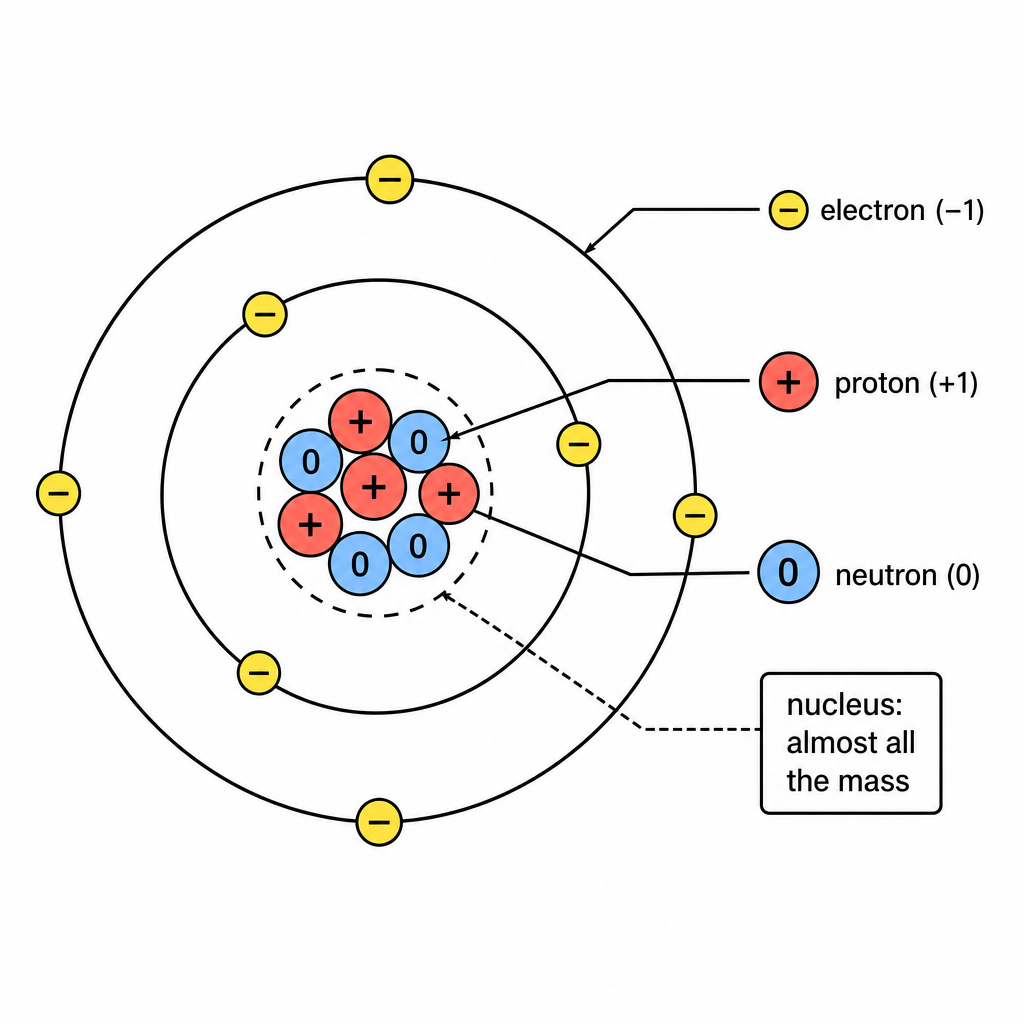
> 🔑 Key idea: protons = $Z$; electrons = $Z$ (if neutral); neutrons = $A − Z$. The only sum you do is the neutrons. 🔢
Worked Example: Count the ParticlesE2.2
Problem A zinc atom has proton number 30 and nucleon number 65. How many protons, electrons and neutrons?
Step 1 Protons = 30. Electrons = 30 (neutral).
Step 2 Neutrons = $65 − 30 = 35$.
So 30 protons, 30 electrons, 35 neutrons. Only the neutrons need a subtraction. ✅
IsotopesE2.3
Isotopes are atoms of the same element (same protons) with different numbers of neutrons — like $^{35}\text{Cl}$ and $^{37}\text{Cl}$. Because they have the same electrons, they have identical chemical properties (reactions are all about electrons). And because an element is a mix of isotopes, its relative atomic mass ($A_r$) is a weighted average, which is why $A_r$ values aren't whole numbers.
> 🔑 Key idea: Isotopes = same protons, different neutrons, same chemistry. $A_r = \dfrac{\sum(\text{mass} \times \%)}{100}$. ⚖️
Worked Example: Relative Atomic MassE2.3
Problem Potassium is 90% mass 39 and 10% mass 41. Find $A_r$ to one decimal place.
Step 1 $39 \times 90 = 3510$ and $41 \times 10 = 410$. Add: $3920$.
Step 2 Divide by 100: $3920 \div 100 = 39.2$.
So 39.2 — close to 39 because most atoms are the lighter isotope. ✅
Working BackwardsE2.3
Sometimes they give you the $A_r$ and ask for the percentages. Same formula, just solved the other way: let one isotope's fraction be $x$, the other is $(1−x)$, set the weighted average equal to the $A_r$, and solve. The answer always sits closer to whichever isotope is more common, so use that as a sanity check.
> 🔑 Key idea: Set $(\text{mass}_1)x + (\text{mass}_2)(1−x) = A_r$ and solve for $x$. The bigger percentage is the isotope nearer the $A_r$. 🔙
Worked Example: Find the PercentagesE2.3
Problem Copper has copper-63 and copper-65, and $A_r = 63.5$. Find the abundances.
Step 1 Let copper-63 be $x$: $63x + 65(1−x) = 63.5$, so $65 − 2x = 63.5$.
Step 2 $2x = 1.5$, so $x = 0.75$.
So 75% copper-63 and 25% copper-65. (Check: gives 63.5 ✓.) ✅
Ions and Ionic BondsE2.4
An ion is a charged atom that lost or gained electrons to get a full outer shell. Metals lose → positive ions; non-metals gain → negative ions. Ionic bonding is the strong attraction between opposite charges, and the ions pack into a giant lattice. That's why ionic compounds have high melting points (strong forces everywhere) and conduct only when molten or dissolved (the ions are then free to move).
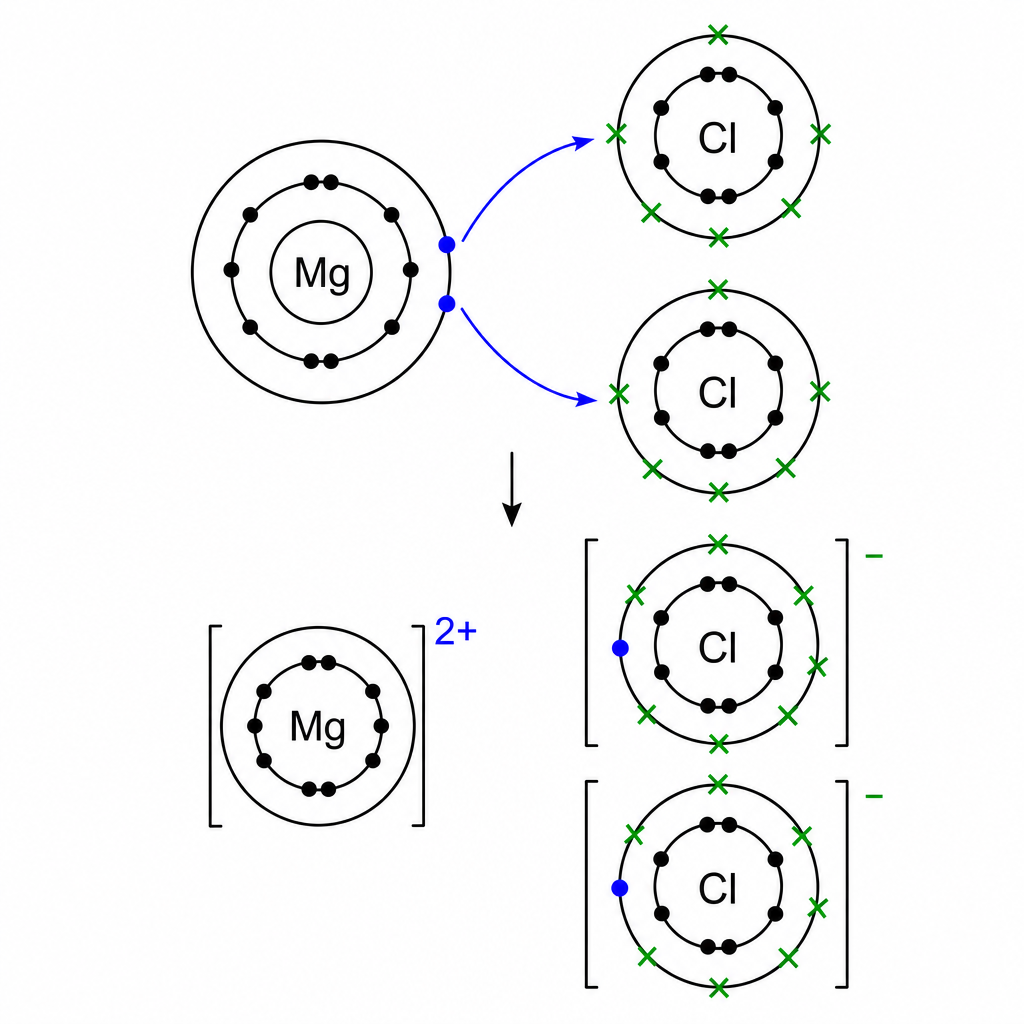 ²⁺" and two "[Cl]⁻". Caption: "Mg gives one electron to each Cl → MgCl₂". Clean black-on-white line diagram, outer electrons only.]
> 🔑 Key idea: Metals lose electrons (+ ions), non-metals gain (− ions). Ionic = strong attraction in a giant lattice. Conducts only when molten (ions free to move) — never say "free electrons" for ionic. ➕➖
Worked Example: Make Magnesium ChlorideE2.4
Problem Magnesium (2,8,2) reacts with chlorine. Describe the electron transfer and give the formula.
Step 1 Magnesium gives away its 2 outer electrons → $\text{Mg}^{2+}$. Each chlorine needs 1 → $\text{Cl}^-$.
Step 2 So one Mg gives one electron to two chlorine atoms. Charges balance → $\text{MgCl}_2$.
Don't write "MgCl" — chlorine only needs one electron, so you need two of them. ✅
Same Electron ArrangementE2.4
Here's a classic Extended twist: different particles can have the exact same electron arrangement. An atom, a positive ion and a negative ion can all end up as, say, 2,8,8 (18 electrons) — they just have different numbers of protons, which keeps them different species. To find matches, just count the electrons and look for anything with that total.
> 🔑 Key idea: Same electron configuration ≠ same element. Count the electrons; the proton number is what actually makes them different. 👯
Worked Example: Who Else Is 2,8,8?E2.4
Problem $\text{Ca}^{2+}$ is 2,8,8 (18 electrons). Which atom and which negative ion are also 2,8,8?
Step 1 18 electrons as an atom → proton number 18 → argon (Ar).
Step 2 18 electrons as a negative ion → chlorine (2,8,7) gains 1 → $\text{Cl}^-$.
So argon and $\text{Cl}^-$. Same 2,8,8, different protons. ✅
Covalent Bonds and Simple MoleculesE2.5
A covalent bond is a shared pair of electrons between two non-metals (they both want electrons, so they share). One pair = single bond, two = double, three = triple. Simple molecular substances are small separate molecules: strong bonds inside each molecule, but weak forces between molecules. So they have low melting/boiling points (you only break the weak forces) and don't conduct (neutral molecules, no free charges).
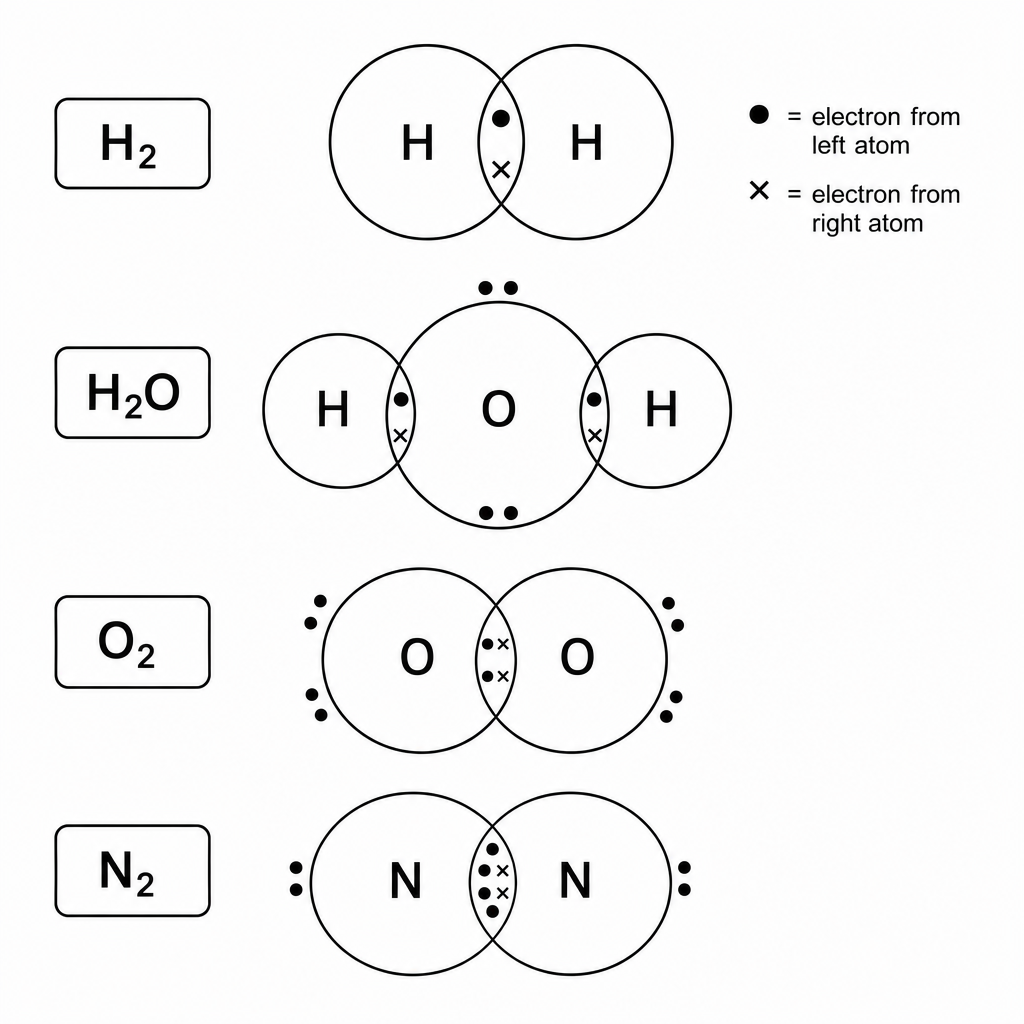
> 🔑 Key idea: Covalent = shared pair. Simple molecular = low melting point (weak forces between molecules, not the strong bonds inside) and no conducting. 🤝
Worked Example: Count the BondsE2.5
Problem Ethanol is $\text{CH}_3\text{CH}_2\text{OH}$. How many covalent bonds in one molecule?
Step 1 C–H bonds: 3 + 2 = 5.
Step 2 Plus C–C (1), C–O (1), O–H (1): $5 + 1 + 1 + 1 = 8$.
So 8 bonds. Count the lines you'd draw — and don't forget the O–H. ✅
Giant Covalent StructuresE2.6
Some covalent substances aren't little molecules — they're giant networks of atoms all joined by strong covalent bonds: diamond, graphite and silicon(IV) oxide. To melt them you break loads of strong bonds, so they're super hard with very high melting points. Diamond (each C bonded to 4) is hard and doesn't conduct. Graphite (each C bonded to 3, in sliding layers) is soft, a lubricant, and conducts (spare electron per carbon). $\text{SiO}_2$ is diamond-like.
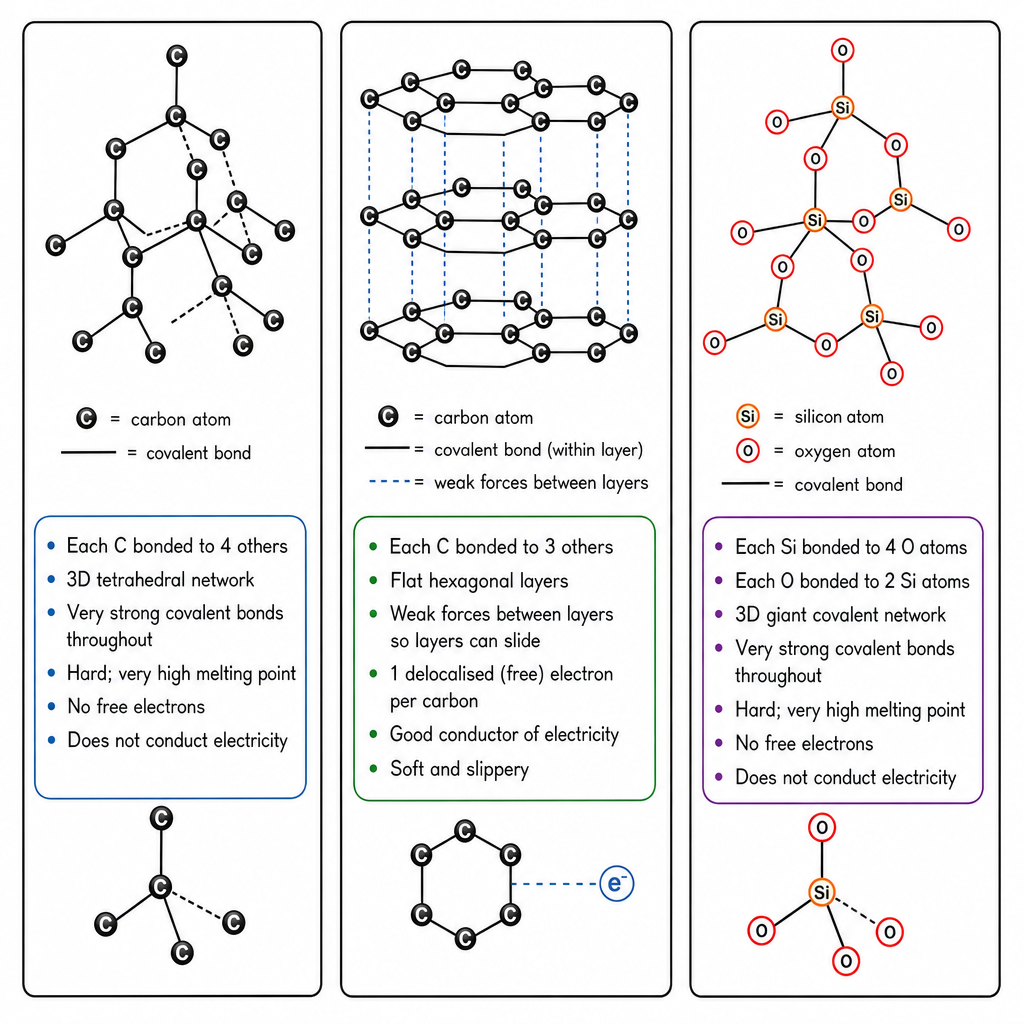
> 🔑 Key idea: Giant covalent = strong-bond network → hard, high melting point. Graphite conducts (3 bonds, spare electron, layers slide); diamond and $\text{SiO}_2$ don't (4 bonds each). 💎
Worked Example: Diamond vs GraphiteE2.6
Problem How many carbons does each carbon bond to in graphite and diamond? Why does graphite conduct but diamond not?
Step 1 Graphite: each C bonds to 3 → one spare electron is free → conducts.
Step 2 Diamond: each C bonds to 4 → all electrons used → none free → doesn't conduct.
Graphite 3 (conducts), diamond 4 (doesn't). ✅
Metallic BondingE2.7
A metal = positive metal ions sitting in a "sea" of delocalised (free) electrons. Metallic bonding is the strong attraction between the ions and that electron sea. This explains everything metals do: they conduct (free electrons move, even when solid), they're malleable (layers of ions slide while the electron sea holds them), and they have high melting points. Alloys are harder because different-size atoms stop the layers sliding.
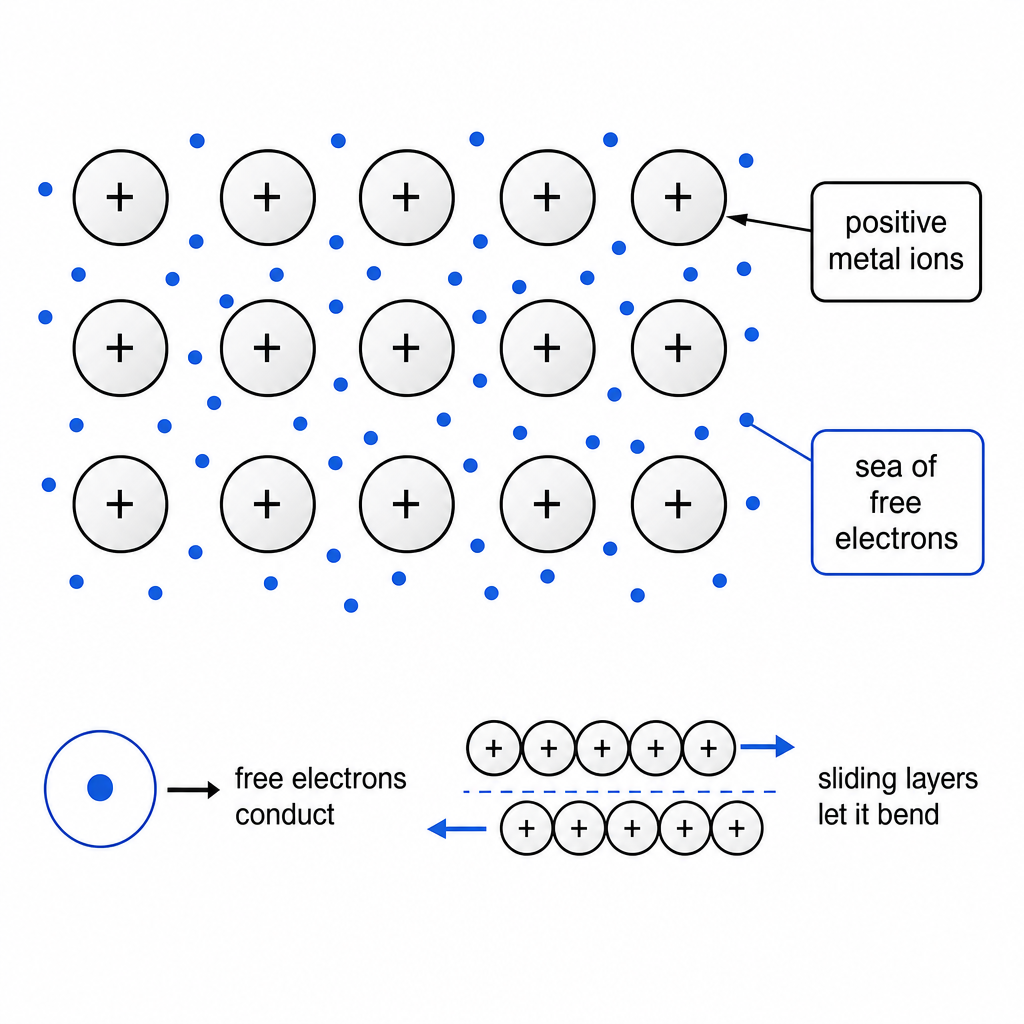
> 🔑 Key idea: Metal = positive ions + sea of free electrons. Conducts by free electrons (even solid); bends because layers slide; alloys harder (different-size atoms block sliding). 🌊
Worked Example: Why Copper ConductsE2.7
Problem Describe the bonding in copper and explain why solid copper conducts.
Step 1 Copper = positive metal ions in a sea of delocalised electrons, held by strong attraction between them.
Step 2 The free electrons move, carrying charge — even when solid.
Metal = free electrons carry charge (not ions). ✅
Key Points to Remember
- Element = one type of atom; compound = elements chemically joined in a fixed ratio (new properties); mixture = not joined, any ratio (split physically).
- Atom: protons (+1, 1) and neutrons (0, 1) in the nucleus, electrons (−1, ≈0) in shells. $Z$ = protons; $A$ = protons + neutrons; neutrons = $A − Z$.
- Shells fill 2, 8, 8. Period = shells; group = outer electrons.
- Isotopes = same protons, different neutrons, same chemistry. $A_r$ = weighted average of isotope masses (works backwards too).
- Ionic (metal + non-metal): electrons transferred; strong attraction in a giant lattice; high melting point; conducts only molten/dissolved (ions free to move).
- Covalent (non-metals): shared pairs. Simple molecular = low melting/boiling points (weak forces between molecules), no conducting.
- Giant covalent (diamond, graphite, $\text{SiO}_2$) = strong-bond networks → hard, high melting points. Graphite conducts; diamond and $\text{SiO}_2$ don't.
- Metallic = positive ions + sea of free electrons. Conducts (even solid), malleable (layers slide); alloys harder.