Introduction
Okay, this is the chapter where chemistry stops being a list of facts and starts actually explaining stuff. Every single thing here comes back to one picture: tiny particles bumping into each other, breaking old bonds, and making new ones.
Hold that picture and the whole chapter clicks: a change is chemical if new stuff forms, a reaction is fast when particles collide often and hard enough, it hits equilibrium when the forward and backward reactions tie, and it's redox when electrons get passed around. This is your quick refresh, not the full textbook: one key idea per topic, one worked example, and the exact move the marker is paying for. Let's get into it. ⚡
Physical vs Chemical ChangesE6.1
Every change is one of two types, and the whole thing rests on one question: did any new substance get made? A physical change just rearranges the same particles (melting, boiling, dissolving, crushing), it's usually easy to undo, and the mass doesn't change. A chemical change breaks and remakes bonds to make brand-new substances with different properties, and the tells are a colour change, a gas, a precipitate, light or heat given out, and a result you can't just cool or evaporate back.
> 🔑 Key idea: No new substance = physical (and reversible). New substance with new properties = chemical. Melting and dissolving keep it the same; burning, rusting, and decomposing make something new. 🎯
Worked Example: A Burning CandleE6.1
Problem A candle burns. In change X, solid wax melts into liquid wax. In change Y, wax vapour burns to form new gases. Classify X and Y.
Step 1 Change X: solid wax becomes liquid wax. It's still wax, only the state changed, and cooling re-solidifies it. That's a physical change.
Step 2 Change Y: wax vapour plus oxygen makes carbon dioxide and water vapour, totally new substances you can't get the wax back from. That's a chemical change.
So X is physical, Y is chemical. Same object, both kinds of change at once, so always classify each step on its own. ✅
Conservation of MassE6.1
Atoms never get created or destroyed in a reaction, they just get rearranged, so total mass is always conserved. If the mass looks like it changed, a gas snuck in or escaped. Something that gains mass (like iron rusting) grabbed a gas from the air; something that loses mass (like a burning sparkler) let a gas escape. Weigh the gas too and the books balance perfectly.
> 🔑 Key idea: Mass is always conserved. An apparent gain means a gas was absorbed; an apparent loss means a gas escaped. "Mass increased so mass was created" is an instant zero. 👀
Worked Example: Iron Gaining MassE6.1
Problem Iron left in damp air turns into reddish-brown rust, and the rusted iron weighs more than the original iron. A student says mass was created. What actually happened?
Step 1 Rust is a new substance (hydrated iron(III) oxide) with new properties, flaky and no longer shiny, so this is a chemical change. Mass was not created from nothing.
Step 2 The extra mass is oxygen from the air combining with the iron. Those oxygen atoms were floating free and are now locked into the solid rust. Weigh the air used up too and total mass before equals total mass after.
Conservation of mass holds, the iron just pulled mass out of the air. ✅
Rate and Collision TheoryE6.2
Rate is just how fast reactants get used up or products form. Collision theory explains all of it: particles only react if they collide and the collision clears two bars, enough energy (at least the activation energy) and the correct orientation. Particles collide billions of times a second but most are too gentle or badly aimed, so only a small fraction are "successful". Rate = number of successful collisions per second. Heating up speeds things because particles move faster (collide more often) and a bigger fraction now clear the activation energy.
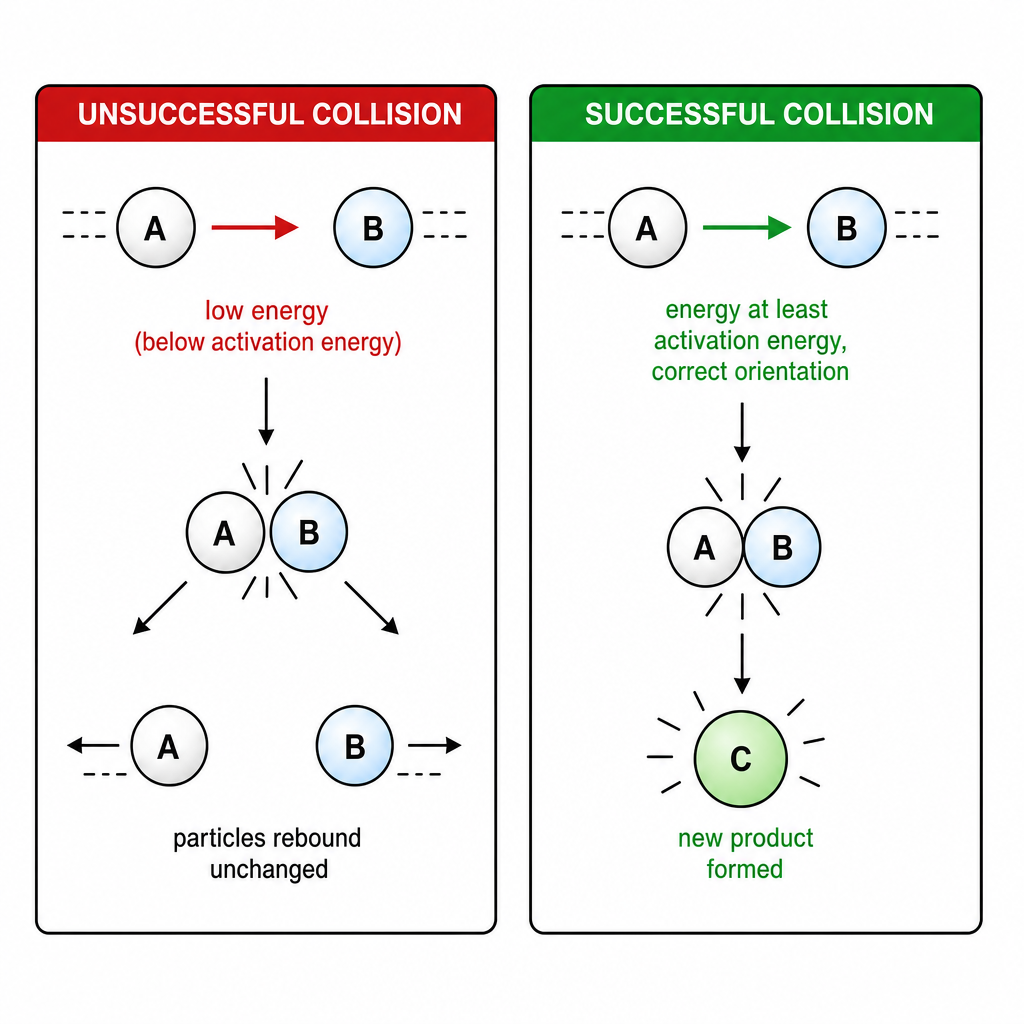
> 🔑 Key idea: Particles react only when they collide with energy ≥ the activation energy AND the right orientation. Anything that raises rate either makes collisions more frequent or makes more of them successful. 🎯
Worked Example: Why Heating Speeds It UpE6.2
Problem Using collision theory, explain why raising the temperature increases the rate of a reaction. (3 marks)
Step 1 Three linked ideas for three marks. First: the particles gain kinetic energy and move faster. Second: faster particles collide more frequently.
Step 2 Third: a greater proportion of collisions now have energy at or above the activation energy, so more are successful.
More successful collisions per second means a faster rate. Heads up: temperature does not lower the activation energy, that's the catalyst's job. ✅
The Factors That Change RateE6.2
Five levers change rate, and most of them work by changing how often particles meet. Higher concentration packs more particles into the same volume; higher pressure squeezes gas particles closer; bigger surface area (powdering a solid) exposes more of it. All three raise collision frequency only. Temperature is the powerhouse because it raises frequency and the successful fraction. A catalyst is its own thing: it gives an alternative pathway with a lower activation energy, so more collisions succeed, and it comes out chemically unchanged.
> 🔑 Key idea: Concentration, pressure, and surface area raise collision frequency. Temperature does both. A catalyst lowers the activation energy so a bigger fraction succeeds, and it never changes the yield. ⚡
Worked Example: Stronger Acid, Faster RateE6.2
Problem Powdered copper(II) carbonate reacts with dilute sulfuric acid. Using more concentrated acid (everything else the same) speeds the reaction up. Explain why, in terms of particles.
Step 1 More concentrated acid means more acid particles in a given volume, so the particles are more crowded.
Step 2 More crowded particles collide more often with the carbonate (higher collision frequency), so more successful collisions happen per second and the rate goes up.
Watch the trap: concentration changes only how often particles meet, not how energetic the collisions are. ✅
Catalysts and Activation EnergyE6.2
A catalyst speeds a reaction up but comes out chemically unchanged, so you can reuse it. It works by offering an alternative pathway with a lower activation energy, which means a bigger proportion of colliding particles now have enough energy to react. The big "do not forget" is what a catalyst leaves untouched: it doesn't change the products, the yield, or the enthalpy change. It just gets you to the exact same place faster.
> 🔑 Key idea: A catalyst lowers the activation energy via a new pathway, so more collisions succeed. It never changes the yield, the position of equilibrium, or the enthalpy change. "Catalyst increases the yield" is a top misconception. 🚫
Worked Example: What a Catalyst ChangesE6.2
Problem A catalyst is added to a reaction. Which is correct? (A) the enthalpy change stays unchanged; (B) the activation energy is increased; (C) the collision frequency is decreased; (D) the kinetic energy of the particles is increased.
Step 1 Knock out the wrong ones. A catalyst lowers the activation energy so B is wrong; it doesn't change how often particles collide so C is wrong; it doesn't give particles more energy (that's heating) so D is wrong.
Step 2 What it genuinely leaves alone is the enthalpy change: same reactants, same products, same energy levels.
So the answer is A. The reactants and products sit at the same levels either way, only the hill between them is lower. ✅
Reversible Reactions and EquilibriumE6.3
Some reactions run both ways: the products can react to re-make the reactants, shown by the double arrow $\rightleftharpoons$. Run one in a closed system (nothing in or out) and eventually the forward and reverse rates become equal, which is dynamic equilibrium. At equilibrium the forward rate equals the reverse rate, the concentrations stay constant (not equal, just unchanging), and both reactions are still happening. "Dynamic" is the whole point: nothing looks like it's changing, but underneath both reactions are still running and cancelling out.
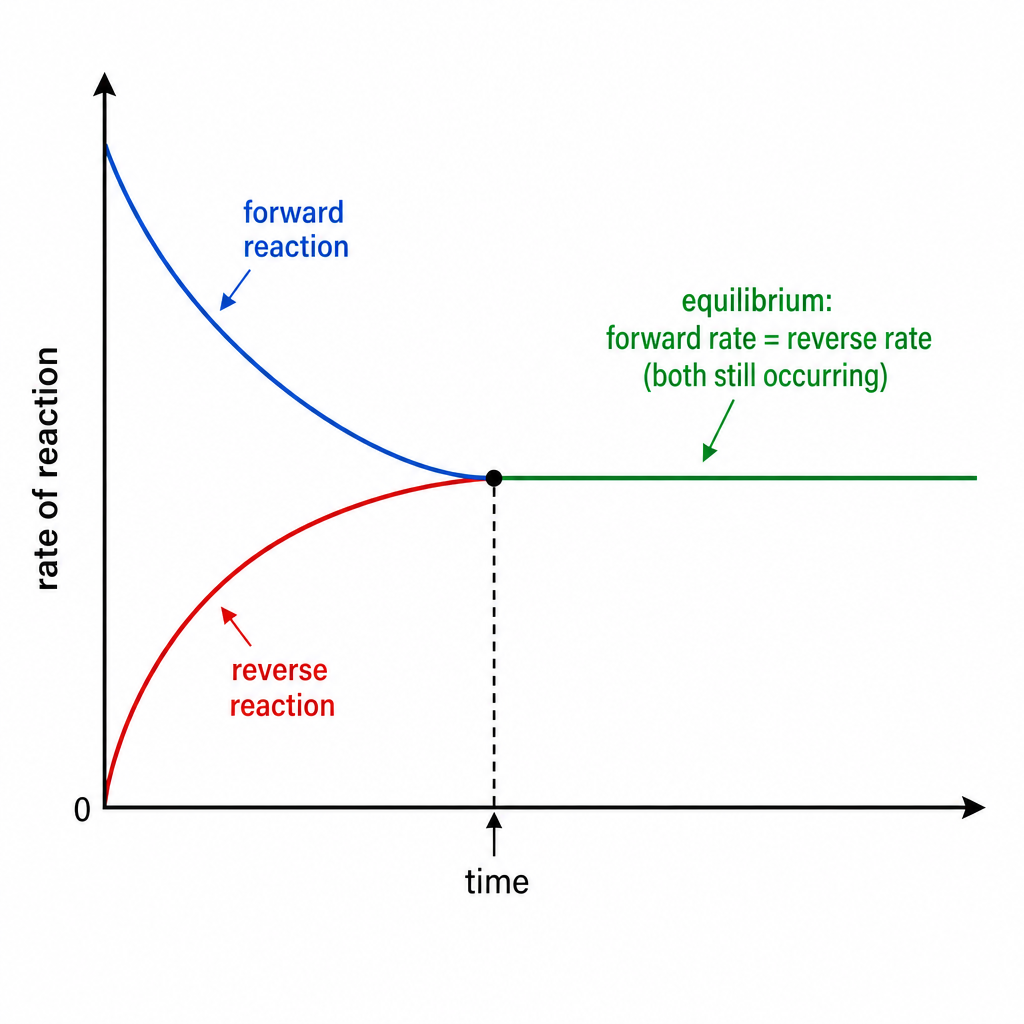
> 🔑 Key idea: Dynamic equilibrium (closed system): forward rate = reverse rate, concentrations constant but usually unequal, both reactions still going. Constant ≠ equal. ⚖️
Worked Example: Two Features of EquilibriumE6.3
Problem A reversible reaction reaches equilibrium in a closed system. State two correct characteristics of this equilibrium.
Step 1 Feature one: the rate of the forward reaction equals the rate of the reverse reaction.
Step 2 Feature two: the concentrations of reactants and products stay constant.
Both reactions keep going at the molecular level, they just cancel out so there's no net change. Don't write "the forward reaction has stopped" or "the concentrations are equal", those are the classic wrong answers. ✅
Le Chatelier and the Industrial Big TwoE6.3
Change a condition and the equilibrium shifts to oppose your change (Le Chatelier). Add a substance, it shifts away from it; raise the pressure, it shifts to the side with fewer gas moles; raise the temperature, it shifts in the endothermic direction. A catalyst shifts nothing, it just reaches equilibrium faster. This is exactly the balancing act behind the Haber process (ammonia: iron catalyst, ~450 °C, ~200 atm) and the Contact process (sulfur trioxide: vanadium(V) oxide catalyst, ~450 °C, ~2 atm). The conditions are always a compromise between yield, rate, and cost.
> 🔑 Key idea: Add substance → shift away; raise pressure → fewer gas moles; raise temperature → endothermic direction. Haber: Fe, 200 atm, ammonia. Contact: V₂O₅, 2 atm, sulfur trioxide. Both ~450 °C. 🏭
Worked Example: Why the Haber CompromiseE6.3
Problem Explain why the Haber process runs at about 450 °C and about 200 atm rather than at the conditions that would give the highest possible yield of ammonia.
Step 1 The forward reaction is exothermic, so a low temperature would give a higher yield, but it would make the rate way too slow to be useful. So 450 °C is a compromise that gives a decent yield at a workable rate.
Step 2 A very high pressure would also raise the yield (fewer gas moles on the product side), but it pushes equipment cost and danger up sharply, so 200 atm balances yield against cost.
The conditions that maximise yield aren't the ones that make the process economic, so the chosen conditions balance yield, rate, and cost (and unreacted gas gets recycled). ✅
Redox: Electron TransferE6.4
Redox means oxidation and reduction happening together: electrons one species loses are gained by another, always as a pair. The chant is OIL RIG, Oxidation Is Loss of electrons, Reduction Is Gain of electrons. This electron definition is the powerful one because it still works when there's no oxygen anywhere (displacement reactions, ionic reactions). You can also spot redox by oxidation number: oxidation = an increase in oxidation number, reduction = a decrease.
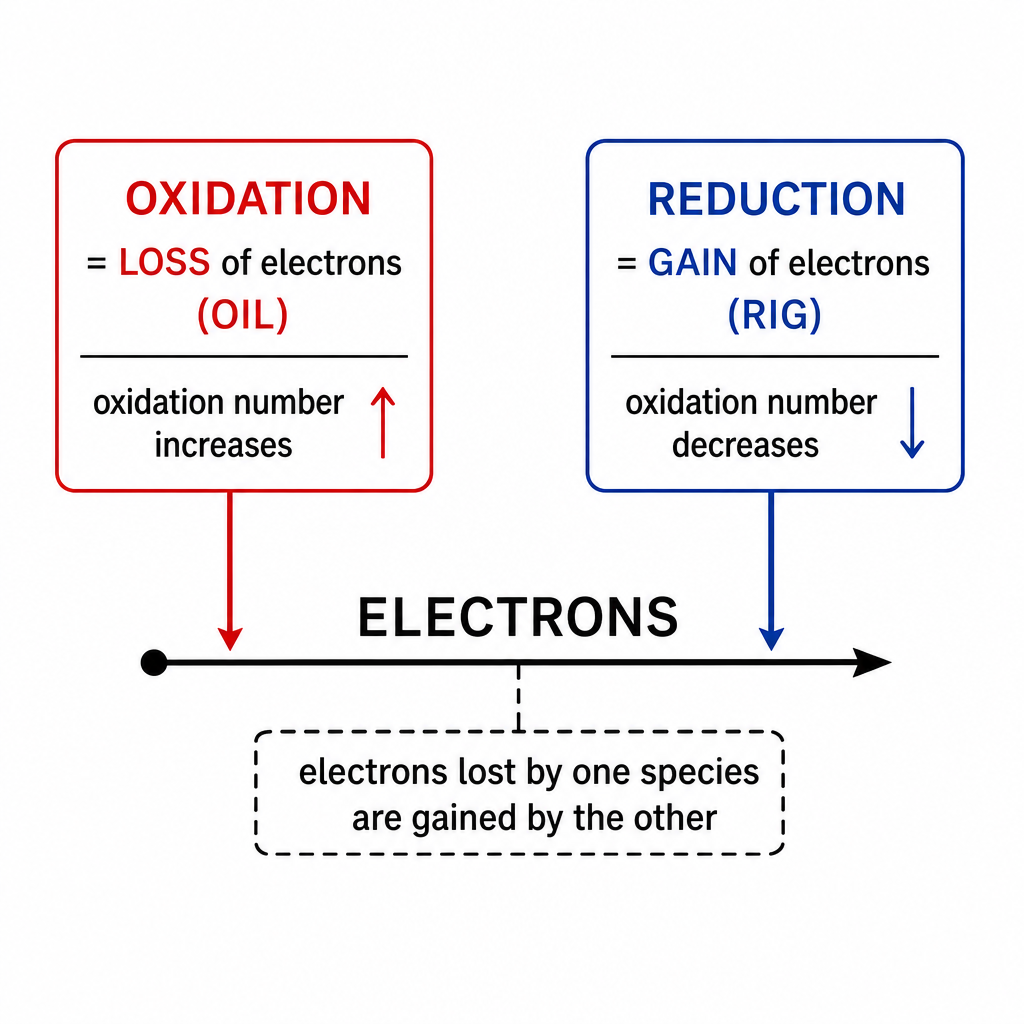
> 🔑 Key idea: OIL RIG: Oxidation Is Loss, Reduction Is Gain (of electrons). Oxidation = oxidation number goes up; reduction = it goes down. They always happen together. 🔋
Worked Example: Zinc Displaces CopperE6.4
Problem In the displacement reaction $\text{Zn} + \text{Cu}^{2+} \rightarrow \text{Zn}^{2+} + \text{Cu}$, describe the electron transfer.
Step 1 Each zinc atom becomes a $\text{Zn}^{2+}$ ion, so it loses two electrons. That's oxidation (OIL).
Step 2 Each $\text{Cu}^{2+}$ ion becomes a copper atom, so it gains two electrons. That's reduction (RIG).
The two electrons lost by zinc are exactly the two gained by each copper ion, so charge is conserved. Count from the change in charge: 0 to 2+ is a loss of two, not one. ✅
Oxidising and Reducing AgentsE6.4
The agents are named for their effect on the other substance, which feels backwards until it clicks. An oxidising agent oxidises something else, which means it grabs electrons, so it is itself reduced. A reducing agent reduces something else by giving electrons, so it is itself oxidised. The trick to never getting this wrong: tie the agent to the substance that changed in the opposite direction to the agent's name. Oxidising agent ↔ gets reduced. Reducing agent ↔ gets oxidised.
> 🔑 Key idea: Oxidising agent = the thing that is itself reduced (it takes electrons). Reducing agent = the thing that is itself oxidised (it gives electrons). Always named for what it does to its partner. 🔀
Worked Example: Iron and BromineE6.4
Problem In $6\text{FeSO}_4 + 3\text{Br}_2 \rightarrow 2\text{Fe}_2(\text{SO}_4)_3 + 2\text{FeBr}_3$, iron is oxidised from +2 to +3 and bromine is reduced from 0 to −1. Identify the oxidising agent and the reducing agent.
Step 1 Bromine is reduced (0 → −1), so it took electrons from the iron, meaning it oxidised the iron. So $\text{Br}_2$ is the oxidising agent.
Step 2 The iron(II) in $\text{FeSO}_4$ is oxidised (+2 → +3), so it gave electrons to the bromine, meaning it reduced the bromine. So $\text{FeSO}_4$ is the reducing agent.
Oxidising agent is $\text{Br}_2$, reducing agent is $\text{FeSO}_4$. Remember: the oxidising agent is the one that gets reduced. ✅
Key Points to Remember
- Physical change = no new substance (easily reversed); chemical change = new substances with new properties.
- Mass is always conserved; an apparent gain means a gas was absorbed, a loss means a gas escaped.
- Collision theory: particles react only when they collide with energy ≥ the activation energy and the right orientation. Rate = successful collisions per second.
- Concentration, pressure, and surface area raise collision frequency; temperature raises both frequency and the successful fraction; a catalyst lowers the activation energy and never changes the yield.
- A reversible reaction ($\rightleftharpoons$) reaches dynamic equilibrium in a closed system: forward rate = reverse rate, concentrations constant (not equal), both reactions still running.
- Le Chatelier: add a substance → shift away; raise pressure → fewer gas moles; raise temperature → endothermic direction; a catalyst shifts nothing.
- Haber: N₂ + 3H₂ ⇌ 2NH₃, iron, ~450 °C, ~200 atm. Contact: 2SO₂ + O₂ ⇌ 2SO₃, V₂O₅, ~450 °C, ~2 atm. Conditions are compromises.
- Redox = oxidation and reduction together. OIL RIG; oxidation = loss of electrons / increase in oxidation number. An oxidising agent is itself reduced; a reducing agent is itself oxidised.