Introduction
Okay so electrochemistry sounds intense, but it's basically one trick: shove electricity through a liquid full of ions and you can rip a compound apart, coat cheap metal in gold, or pull out a metal that's way too reactive to get any other way. Same energy, run backwards, gives you a fuel cell that powers a car on hydrogen.
The whole thing runs on one picture: ions that are free to move get pulled to charged rods (electrodes) and swap electrons there. Lock that in and every prediction follows from two tiny rules. This is your fast refresh, not the full textbook: one key idea per topic, one quick worked example, and the exact move the marker wants. Let's split some stuff. ⚡
What Electrolysis Actually IsE4.1
Electrolysis is breaking down an ionic compound, when it's molten (melted) or dissolved in water, by passing electricity through it. The catch: the ions have to be free to move. A solid ionic compound has ions, but they're locked in place, so nothing happens. Melt it or dissolve it and the ions break loose, drift to the rods, and get discharged. Covalent compounds don't play at all, because they've got no ions to begin with.
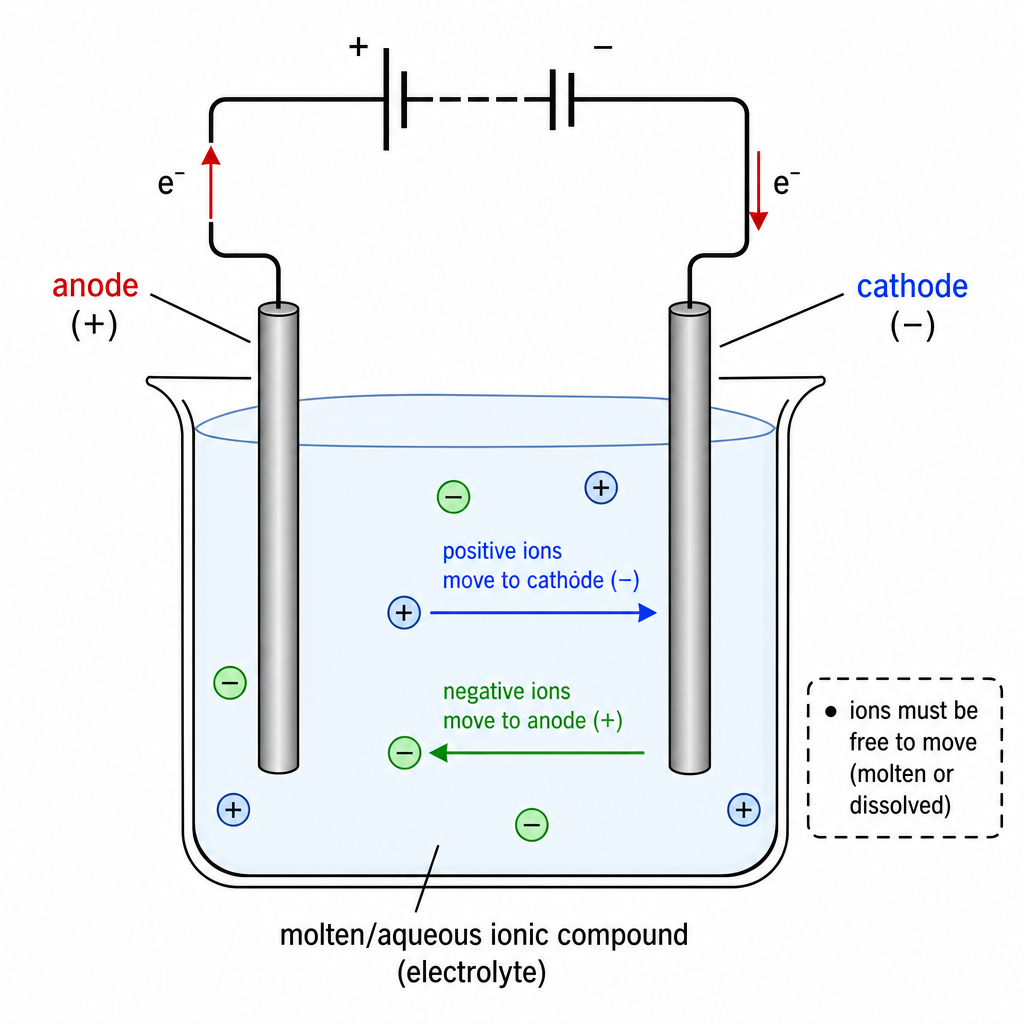
> 🔑 Key idea: Electrolysis only works on ionic compounds that are molten or in solution, because the ions need to be free to move. Solids and covalent compounds don't conduct. 🎯
Worked Example: Defining ElectrolysisE4.1
Problem Electrolysis breaks down a certain type of compound, in one of two physical states. Which type, and which two states?
Step 1 Only ionic compounds have ions, so covalent ones are out.
Step 2 The ions can only move when the compound is molten or in aqueous solution (a solid keeps them locked up).
So the answer is ionic compounds, when molten or in aqueous solution. ✅
Anode, Cathode and How Charge MovesE4.1
Name the rods: the cathode is the negative one (positive ions go there) and the anode is the positive one (negative ions go there). The sneaky exam bit is how charge moves. In the wires it's carried by electrons. In the electrolyte it's carried by ions. They never swap jobs: electrons don't swim through the liquid, ions don't crawl down the wires. Use "an ox" (ANode = OXidation) and "red cat" (REDuction at CAThode) to keep the rods straight.
> 🔑 Key idea: Cathode = negative, anode = positive. Charge moves by electrons in the wires and ions in the electrolyte ⚡
Worked Example: What Carries the ChargeE4.1
Problem Molten lead(II) bromide is electrolysed. What carries the charge in the external wires?
Step 1 The wires are metal, and in metal the charge carriers are electrons.
Step 2 Ions ($\text{Pb}^{2+}$, $\text{Br}^-$) only carry charge inside the liquid, not in the wires.
So it's electrons. Don't fall for "ions" here. 🔌
Splitting a Melted CompoundE4.1
When you electrolyse a molten compound of two elements (a metal + a non-metal), there's no water to complicate things, so the rule is dead simple: the metal forms at the cathode and the non-metal forms at the anode. Classic example: molten lead(II) bromide gives lead at the cathode and brown bromine vapour at the anode. Same deal for any molten binary compound.
> 🔑 Key idea: Molten binary compound → metal at the cathode, non-metal at the anode. No water, no competition. 🔥
Worked Example: Molten Zinc OxideE4.1
Problem Molten zinc oxide is electrolysed with inert electrodes. What forms at the anode and the cathode?
Step 1 Molten zinc oxide has $\text{Zn}^{2+}$ and $\text{O}^{2-}$ ions only.
Step 2 Metal to the cathode → zinc. Non-metal to the anode → oxygen.
So oxygen at the anode, zinc at the cathode. Same pattern as lead bromide. ✅
Solutions and the Discharge RulesE4.1
Dissolve the compound in water and suddenly water adds its own $\text{H}^+$ and $\text{OH}^-$ ions, so there's a competition at each rod. Two rules sort it out. Cathode: the less reactive of the metal and hydrogen wins, so copper/silver get deposited but reactive metals (sodium, potassium, aluminium) stay put and you get hydrogen instead. Anode: a halide (Cl, Br, I) wins if it's concentrated, otherwise you get oxygen from the hydroxide. Sulfate and nitrate never come out.
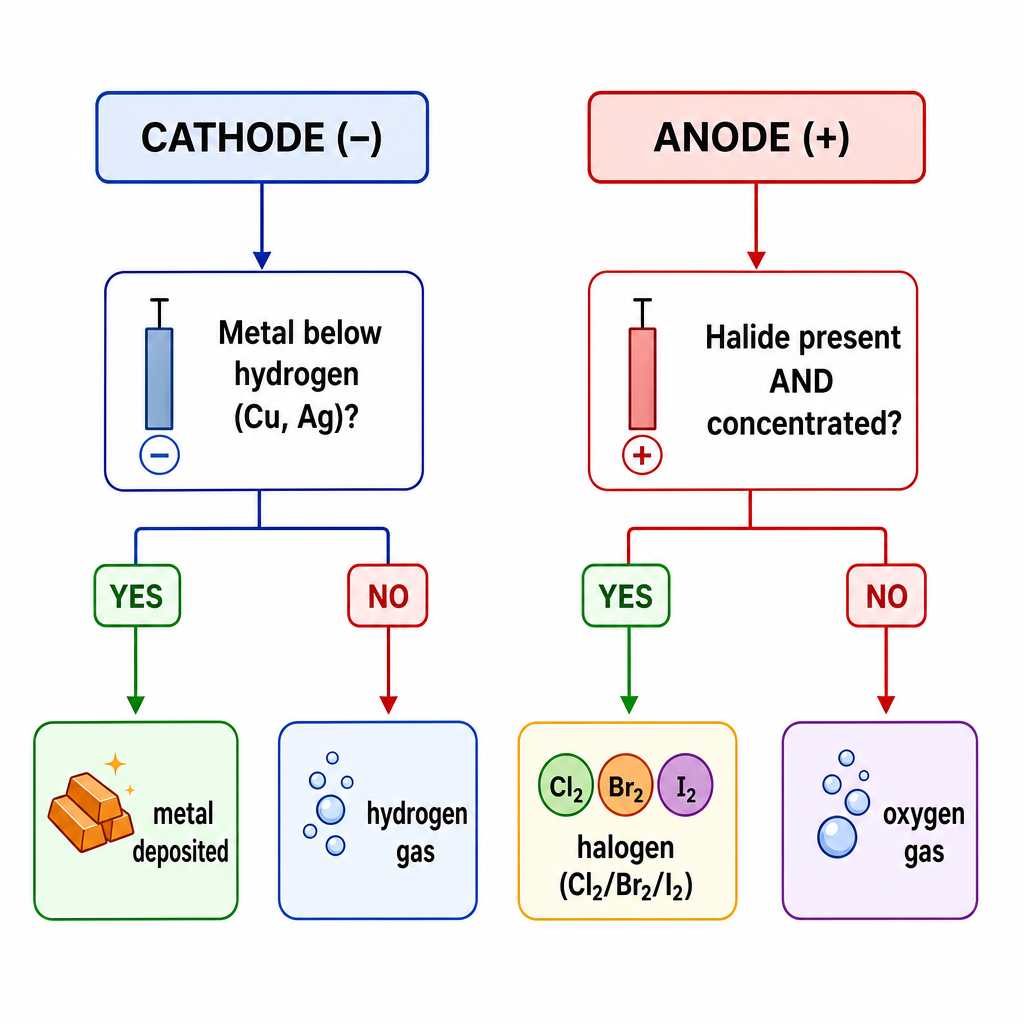
> 🔑 Key idea: In solution — cathode: less reactive of metal/hydrogen; anode: halide if concentrated, else oxygen. Sulfate and nitrate never discharge. 🎯
Worked Example: Concentrated Salt WaterE4.1
Problem Concentrated sodium chloride solution is electrolysed with inert electrodes. What forms at each electrode?
Step 1 Cathode: sodium is more reactive than hydrogen, so the less reactive hydrogen comes out.
Step 2 Anode: chloride is concentrated, so chlorine comes out.
Hydrogen at the cathode, chlorine at the anode. (Make it super dilute and the anode would switch to oxygen.) ✅
Building a Half-EquationE4.1
A half-equation shows what happens at just one rod, and it has to balance for atoms and charge. The trick is the electrons: at the cathode they're gained, so they go on the left; at the anode they're lost, so they go on the right. One thing people forget: halogens, hydrogen and oxygen come out as molecules, so you usually need to start with two ions to build one molecule.
> 🔑 Key idea: Half-equation = balance atoms and charge. Electrons on the left = cathode (gained), on the right = anode (lost). ⚡
Worked Example: Chlorine at the AnodeE4.1
Problem Write the anode half-equation when concentrated sodium chloride is electrolysed.
Step 1 Chlorine is a molecule $\text{Cl}_2$, so start with two chloride ions.
Step 2 They lose two electrons (electrons on the right, because anode):
Atoms balance (2 Cl each side), charge balances (2− each side). ✅
$$2\text{Cl}^- \rightarrow \text{Cl}_2 + 2\text{e}^-$$
Copper Sulfate: Two Setups, Two StoriesE4.1
Same blue copper(II) sulfate, totally different results depending on the rods. With inert (carbon/platinum) electrodes: copper plates onto the cathode (mass up), oxygen bubbles off the anode, and the blue fades because copper ions are being removed and not replaced. With copper electrodes: copper still plates onto the cathode, but now the anode dissolves to put copper ions back, so the blue stays the same. That dissolving-anode trick is exactly how electroplating works.
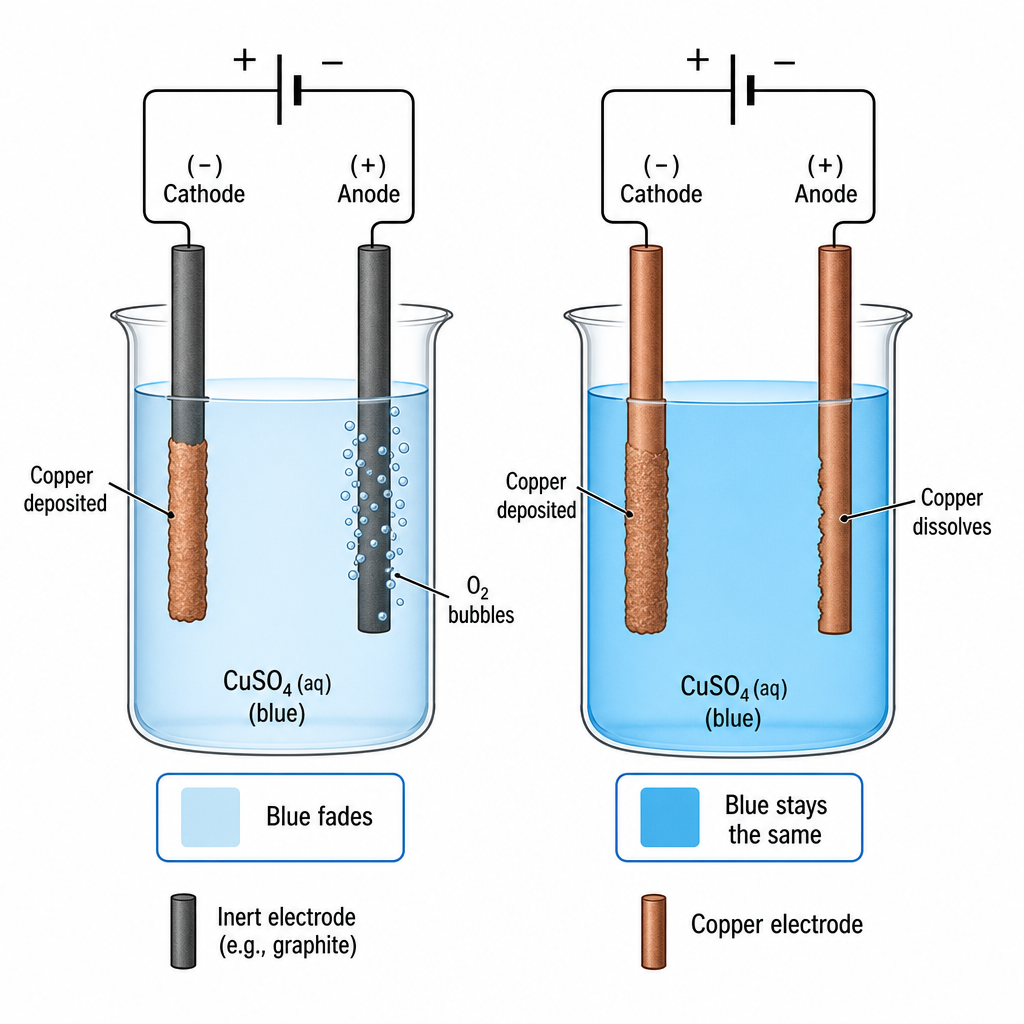
> 🔑 Key idea: Copper(II) sulfate — inert electrodes: blue fades; copper electrodes: blue stays constant (anode dissolves to replace the copper). 🟦
Worked Example: Inert ElectrodesE4.1
Problem Copper(II) sulfate is electrolysed with inert platinum electrodes. What happens to the cathode's mass?
Step 1 Copper is below hydrogen in reactivity, so $\text{Cu}^{2+}$ is discharged and copper is deposited on the cathode.
Step 2 Adding copper means the cathode gains mass (and the blue fades as the copper ions get used up).
So the cathode mass increases. ✅
ElectroplatingE4.1
Electroplating uses electrolysis to put a thin layer of metal on an object, to make it look good and to stop it corroding (and to fake the look of an expensive metal cheaply). The set-up is always the same: the object is the cathode, the anode is the pure plating metal (it dissolves to top up the solution), and the electrolyte is a salt of the plating metal (silver nitrate for silver, copper sulfate for copper).
> 🔑 Key idea: Electroplating: object = cathode, plating metal = anode, electrolyte = a salt of the plating metal. For looks and corrosion protection. ✨
Worked Example: Copper-Plating SteelE4.1
Problem A steel object is plated with copper (object = cathode, copper = anode, electrolyte = copper sulfate). Which are correct? (1) steel turns reddish-brown; (2) the solution fades to paler blue; (3) the copper electrode gets thinner.
Step 1 Copper coats the steel → reddish-brown, so (1) is right. The copper anode dissolves to replace the copper, so the colour stays the same → (2) wrong.
Step 2 The dissolving anode gets thinner → (3) right.
So it's 1 and 3 only. ✅
Extracting AluminiumE4.1
Aluminium is way too reactive to get by heating its ore with carbon, so it's pulled out by electrolysing its molten oxide. The ore is bauxite, purified to aluminium oxide. That oxide melts at a brutal temperature, so it's dissolved in molten cryolite to bring the temperature (and the energy bill) down. The electrodes are carbon, and the carbon anodes slowly burn away because the oxygen made there reacts with them to form carbon dioxide.
> 🔑 Key idea: Aluminium = electrolysis of molten aluminium oxide dissolved in cryolite; the carbon anodes burn away in the oxygen. 🏭
Worked Example: The Aluminium CellE4.1
Problem Aluminium is extracted by electrolysis of aluminium oxide. Write the cathode and anode half-equations, and say why the anode wears away.
Step 1 Cathode (aluminium forms): $\text{Al}^{3+} + 3\text{e}^- \rightarrow \text{Al}$. Anode (oxygen forms): $2\text{O}^{2-} \rightarrow \text{O}_2 + 4\text{e}^-$.
Step 2 The hot carbon anode reacts with that oxygen ($\text{C} + \text{O}_2 \rightarrow \text{CO}_2$), so it burns away and must be replaced. ✅
Hydrogen–Oxygen Fuel CellsE4.2
A hydrogen–oxygen fuel cell is electrolysis run backwards: instead of using electricity to split water, it joins hydrogen and oxygen to make electricity, and the only product is water. The fuel is hydrogen, the oxidising agent is oxygen, and it turns chemical energy straight into electrical energy. It's clean and efficient in use, but here's the catch the exam loves: if the hydrogen was made using fossil fuels, carbon dioxide got released somewhere else, so it's not automatically carbon-free overall.
> 🔑 Key formula: $2\text{H}_2 + \text{O}_2 \rightarrow 2\text{H}_2\text{O}$. Water is the only product; chemical energy → electrical energy. Clean in use, but only low-carbon if the hydrogen is made cleanly. 🚗
Worked Example: The Fuel Cell EquationE4.2
Problem Write the overall equation for the reaction in a hydrogen–oxygen fuel cell.
Step 1 It joins hydrogen and oxygen to make water (the reverse of splitting water).
Step 2 Balance it:
Water is the only product, so no carbon dioxide at the point of use. ✅
$$2\text{H}_2 + \text{O}_2 \rightarrow 2\text{H}_2\text{O}$$
Key Points to Remember
- Electrolysis breaks down an ionic compound, when molten or in solution, using electricity; the ions must be free to move.
- Cathode = negative (cations, reduction, gain electrons); anode = positive (anions, oxidation, lose electrons). OIL RIG.
- Charge: electrons in the wires, ions in the electrolyte.
- Molten binary compound: metal at the cathode, non-metal at the anode.
- In solution: cathode gives the less reactive of metal/hydrogen; anode gives a halide if concentrated, else oxygen (sulfate and nitrate never discharge).
- Half-equations balance atoms and charge; electrons on the left = cathode, right = anode. Learn $2\text{H}^+ + 2\text{e}^- \rightarrow \text{H}_2$ and $4\text{OH}^- \rightarrow 2\text{H}_2\text{O} + \text{O}_2 + 4\text{e}^-$.
- Copper(II) sulfate: inert electrodes → blue fades; copper electrodes → blue stays the same (anode dissolves).
- Electroplating: object = cathode, plating metal = anode, electrolyte = a salt of the plating metal.
- Aluminium is extracted from molten aluminium oxide in cryolite; carbon anodes burn away.
- Fuel cell: $2\text{H}_2 + \text{O}_2 \rightarrow 2\text{H}_2\text{O}$, water the only product, chemical → electrical energy.