Introduction
The Periodic Table looks like a wall of random boxes, but it's secretly the most organised thing in chemistry. Here's the cheat code: elements are lined up by proton number, and that lines up elements with the same number of outer electrons into the same column (Group). Since outer electrons run the chemistry, everything in a column behaves alike, so an element's address basically tells you its personality.
That means you can predict stuff you've never been taught: is it a metal, what charge its ion has, how reactive it is, even its colour and state. This is your fast refresh, not the full textbook: one key idea per topic, one worked example, and the exact move the marker wants. Let's read the table and predict some elements. 🔮
Reading the TableE8.1
The table is just elements in order of proton number, folded into a grid. Two numbers do all the work: the Group (the column, I–VIII) tells you the number of outer-shell electrons, and the Period (the row, 1–7) tells you the number of shells. Metals sit on the left, non-metals on the right, so going across a row you slide from metal to non-metal. Same column = same outer electrons = same vibe.
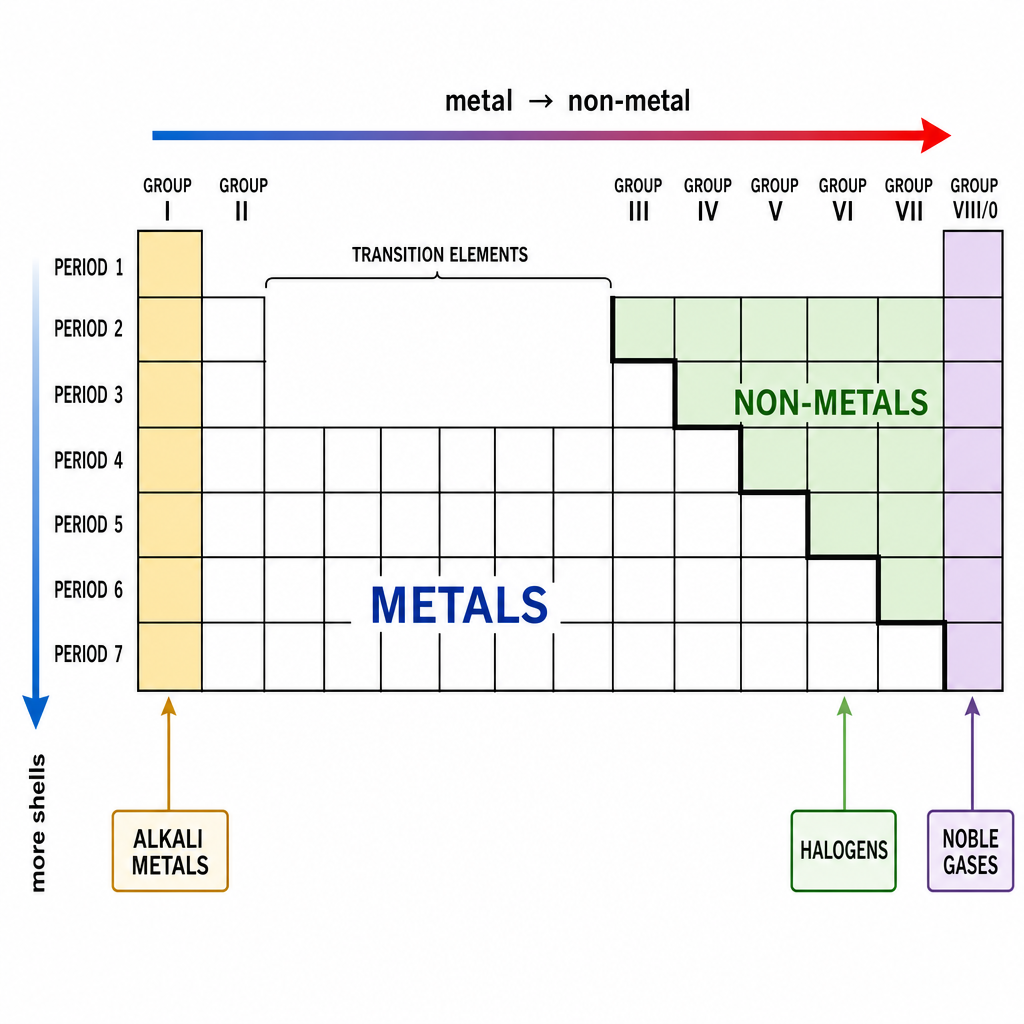
> 🔑 Key idea: Group = column = outer electrons. Period = row = number of shells. Metals left, non-metals right. Position tells you the chemistry. 🗺️
Worked Example: Name That Element TypeE8.1
Problem An element is in Group II. Is it a metal or non-metal, and how many outer electrons does it have?
Step 1 Group II is on the left → it's a metal.
Step 2 Group number = outer electrons → 2 outer electrons (so it makes a 2+ ion).
Metal, 2 outer electrons. Read it straight off the column. ✅
Predicting Ions and FormulaeE8.1
Atoms want a full outer shell, so metals lose their few outer electrons (→ positive ions: Group I → 1+, II → 2+, III → 3+) and non-metals gain electrons (→ negative ions: Group VII → 1−, VI → 2−). To build a formula, just balance the charges so the whole thing is neutral. A 2+ paired with a 1− needs two of the 1− to cancel out, and you're done.
> 🔑 Key idea: Metals lose → + ions; non-metals gain → − ions. Charge from the Group, then balance + and − to get the formula. ⚖️
Worked Example: Build the FormulaE8.1
Problem P is in Group II, Q is in Group VII. What's the formula of their compound?
Step 1 P → $\text{P}^{2+}$ (loses 2). Q → $\text{Q}^-$ (gains 1).
Step 2 One $\text{P}^{2+}$ needs two $\text{Q}^-$ to balance → $\text{PQ}_2$.
The charge size becomes the other's subscript. 🎯
Group I: The Alkali MetalsE8.2
Group I (Li, Na, K…) are the alkali metals: 1 outer electron, makes a 1+ ion, and they're weirdly soft (cut with a knife) and low density (they float). Their party trick is reacting with water to make a metal hydroxide + hydrogen, which turns the water alkaline (indicator goes purple). You'll see the metal float, fizz and skate around the surface.
> 🔑 Key idea: Alkali metals = 1 outer electron, soft, float. With water → hydroxide + hydrogen (alkaline). The gas is hydrogen. 🌊
Worked Example: Sodium Hits the WaterE8.2
Problem Sodium is dropped into cold water with indicator. Give two observations and say why it goes alkaline.
Step 1 It floats, fizzes and moves around (and may melt into a ball).
Step 2 It makes sodium hydroxide (an alkali), so the indicator turns purple.
Hydrogen gas, alkaline solution. Not oxygen. ✅
Group I ReactivityE8.2
Going down Group I the metals get more reactive (and melt at lower temperatures). Why? Each step down adds a shell, so the single outer electron sits further from the nucleus and is held more loosely, so it's lost more easily. Easier to lose the electron = more reactive. Every alkali metal reacts with water the same way: $2\text{M} + 2\text{H}_2\text{O} \rightarrow 2\text{MOH} + \text{H}_2$.
> 🔑 Key idea: Down Group I = more shells = outer electron easier to lose = more reactive. The equation is always $2\text{M} + 2\text{H}_2\text{O} \rightarrow 2\text{MOH} + \text{H}_2$. ⚡
Worked Example: Balance Lithium + WaterE8.2
Problem Write the balanced equation for lithium reacting with water.
Step 1 Products: lithium hydroxide ($\text{LiOH}$) + hydrogen ($\text{H}_2$).
Step 2 Double the Li, water and LiOH:
Li 2=2, O 2=2, H 4=4. Balanced. 🎯
$$2\text{Li} + 2\text{H}_2\text{O} \rightarrow 2\text{LiOH} + \text{H}_2$$
Group VII: The HalogensE8.3
Group VII (F, Cl, Br, I) are the halogens: reactive non-metals with 7 outer electrons that gain 1 to make a 1− ion, and they travel as pairs (diatomic, like $\text{Cl}_2$). Going down, they get darker and more solid: chlorine is a yellow-green gas, bromine a red-brown liquid, iodine a grey-black solid. And here's the twist: unlike the metals, halogens get LESS reactive going down, because gaining an electron gets harder when the outer shell is further out.
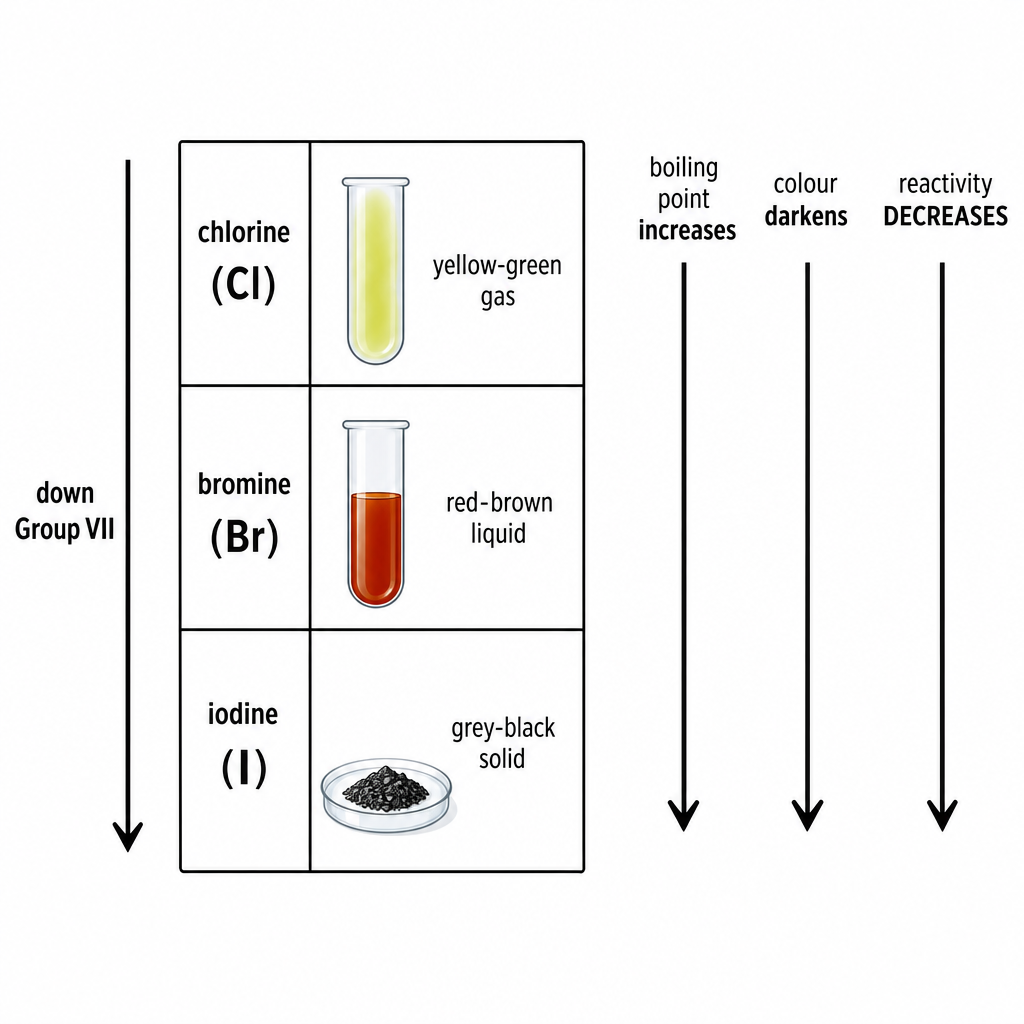
> 🔑 Key idea: Halogens = diatomic non-metals, 1− ions. Down the group: darker, more solid, and less reactive (gaining an electron gets harder). 🎨
Worked Example: Iodine's LookE8.3
Problem What colour and state is iodine at room temperature, and how does it fit the Group VII trend?
Step 1 Iodine is a grey-black solid.
Step 2 Down the group: gas (Cl) → liquid (Br) → solid (I). Iodine being a solid fits perfectly.
The purple is iodine vapour — the solid is grey-black. ✅
Halogen DisplacementE8.3
Since reactivity is Cl > Br > I, a more reactive halogen displaces a less reactive halide from its salt. Chlorine kicks out bromine from potassium bromide, turning the solution orange: $\text{Cl}_2 + 2\text{KBr} \rightarrow 2\text{KCl} + \text{Br}_2$. The potassium just watches (spectator), so the ionic version drops it. Bromine can displace iodide, but iodine can't displace either — it's bottom of the pile.
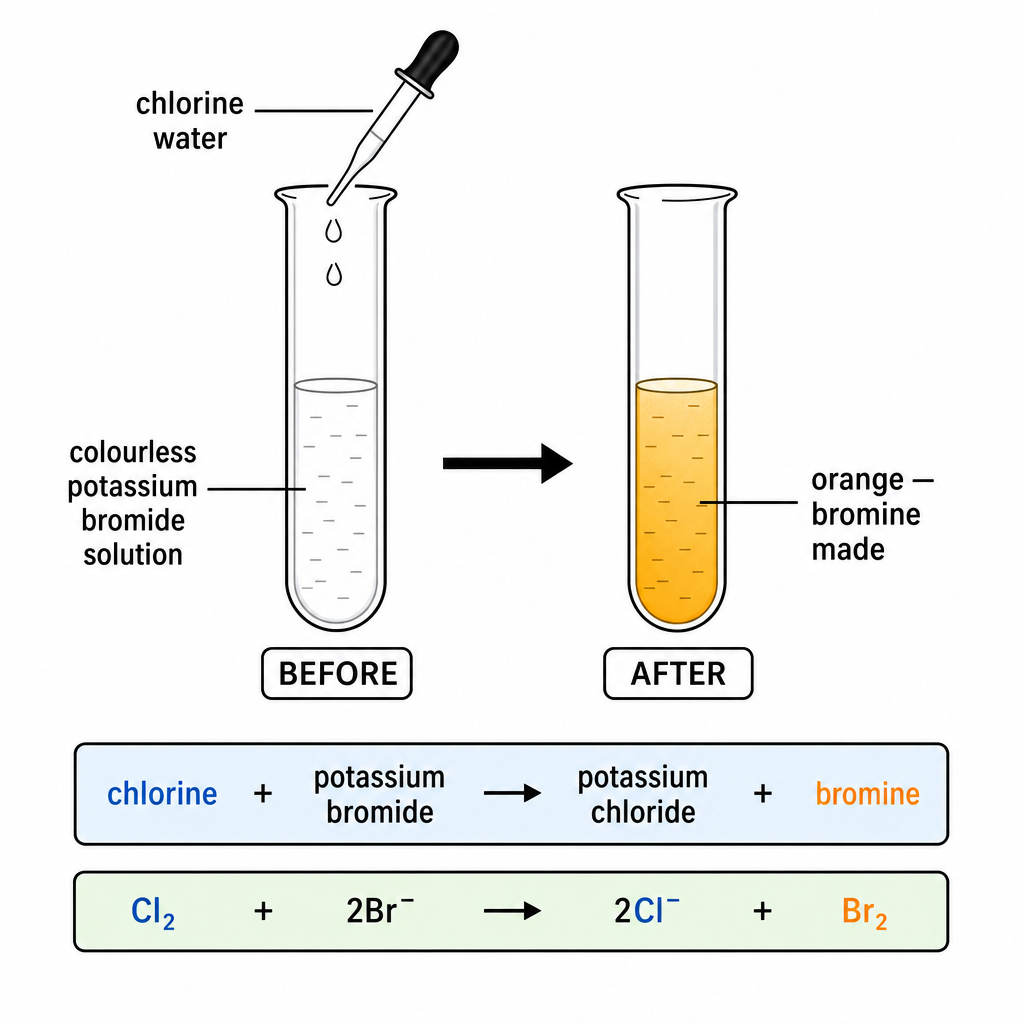
> 🔑 Key idea: More reactive halogen displaces a less reactive halide (Cl > Br > I). Spectators get dropped from the ionic equation. 🥊
Worked Example: Chlorine vs BromideE8.3
Problem Chlorine is bubbled into potassium bromide solution. Write the ionic equation.
Step 1 Chlorine is more reactive → it displaces bromine (orange appears).
Step 2 Drop the spectator $\text{K}^+$:
Element chlorine kicks out bromine from bromide. Balanced for atoms and charge. ✅
$$\text{Cl}_2 + 2\text{Br}^- \rightarrow 2\text{Cl}^- + \text{Br}_2$$
Transition ElementsE8.4
The transition elements (Fe, Cu, Zn…) are the big block in the middle, and they're metals with extra flair. Compared to Group I, they're hard, dense and high-melting, they form coloured compounds (Cu²⁺ blue, Fe²⁺ pale green, Fe³⁺ yellow-brown), they have more than one ion charge (variable oxidation states like Fe²⁺/Fe³⁺), and they make great catalysts (iron in the Haber process).
> 🔑 Key idea: Transition metals = hard, dense, coloured compounds, variable charges, catalysts. That's what separates them from soft Group I. 🎨
Worked Example: Spot the Transition MetalE8.4
Problem Which is a transition element? (A) m.p. 1907 °C, density 7.2 g/cm³, green oxide; (B) m.p. 98 °C, density 1.0 g/cm³, white oxide.
Step 1 Transition signature = high m.p. + high density + coloured compound.
Step 2 A ticks all three (1907 °C, 7.2 g/cm³, green oxide) → A.
One high value isn't enough — you need all three. 🎯
Transition vs Group IE8.4
Careful with "differences" questions: things like conducting electricity and forming basic oxides are shared with Group I (normal metal stuff), so they score zero as differences. The real differences are the special transition powers: variable oxidation states and coloured compounds (plus being harder, denser and catalytic). Copper, for example, does the Cu⁺/Cu²⁺ thing and goes blue — sodium does neither.
> 🔑 Key idea: "Difference" = a transition special (variable charge, coloured compound), NOT a shared metal property like conducting. 🔍
Worked Example: Copper vs SodiumE8.4
Problem Give two ways copper differs from a Group I metal like sodium.
Step 1 Copper has variable oxidation states ($\text{Cu}^+$, $\text{Cu}^{2+}$); sodium is only 1+.
Step 2 Copper makes coloured compounds (blue); sodium's are white.
"Conducts electricity" is shared, so it doesn't count. ✅
Noble GasesE8.5
The noble gases (He, Ne, Ar…) are Group VIII/0 on the far right: single atoms, colourless gases, and famously unreactive. The reason is one thing: a full outer shell (He has 2, the rest 8). With a full shell there's no reason to gain, lose or share electrons, so they just don't react. Plot twist: this is why every other element reacts — they're all trying to reach a full, noble-gas shell.
> 🔑 Key idea: Noble gases = full outer shell → no need to gain/lose/share → unreactive. Everyone else reacts to copy them. 😎
Worked Example: Why So ChillE8.5
Problem Statement 1: "noble gases are reactive." Statement 2: "they have a full outer shell." Which is right, and why does a full shell mean unreactive?
Step 1 Statement 1 is wrong (they're unreactive); statement 2 is correct.
Step 2 Full outer shell → no tendency to gain, lose or share electrons → no reaction.
The mark is "full outer shell". ✅
Key Points to Remember
- The table is ordered by proton number: Group (column) = outer electrons, Period (row) = number of shells. Metals left, non-metals right.
- Ion charge comes from the Group: metals lose (1+, 2+, 3+), non-metals gain (1−, 2−). Balance + and − to get a formula.
- Group I (alkali metals): soft, float, 1+ ions. With water → hydroxide + hydrogen ($2\text{M} + 2\text{H}_2\text{O} \rightarrow 2\text{MOH} + \text{H}_2$). More reactive down the group (outer electron easier to lose).
- Group VII (halogens): diatomic non-metals, 1− ions. Down the group: darker, more solid, less reactive. Stronger halogen displaces weaker halide: $\text{Cl}_2 + 2\text{Br}^- \rightarrow 2\text{Cl}^- + \text{Br}_2$.
- Transition elements: hard, dense, coloured compounds, variable oxidation states, catalysts. Shared metal properties (conducting, basic oxides) aren't differences.
- Noble gases: Group 0, monatomic, unreactive because of a full outer shell — the thing every other atom is chasing.