Introduction
Welcome to one of the most practical topics in Pure Maths! Ever wondered what happens when an equation is just too gnarly to solve exactly? We can't always find a neat answer like $x=2$. That's where numerical methods come in. In this chapter, we're going to become mathematical detectives. First, we'll learn how to locate the neighbourhood of a root using the sign change rule – it's a clever trick that guarantees a root is hiding in a specific interval. Then, we'll zoom in with iterative methods, a powerful technique for getting closer and closer to the exact answer with each step. It's all about smart approximation, and it's a key skill for your exams. Let's get started!
Locating Roots by Change of Sign2.6
Alright, let's get into one of the foundational ideas for solving equations numerically. Think of it like this: you're tracking your favourite streamer's subscriber count. One day they're down 100 subs (a negative change), the next they're up 500 (a positive change). To go from negative to positive, they must have passed the 'zero change' point somewhere in between, right? That's the core logic here!<br><br>In maths, a 'root' of an equation is a value of $x$ that makes $f(x) = 0$. Geometrically, it's simply where the graph of $y=f(x)$ crosses the x-axis. The 'change of sign' method is a super reliable way to prove that a root exists within a specific interval, say between $x=a$ and $x=b$.<br><br>Here's the deal: If a function $f(x)$ is continuous on an interval $[a, b]$ (meaning you can draw its graph without lifting your pen – no weird jumps or asymptotes), and the values of $f(a)$ and $f(b)$ have opposite signs (one is positive, the other is negative), then there must be at least one root between $a$ and $b$. 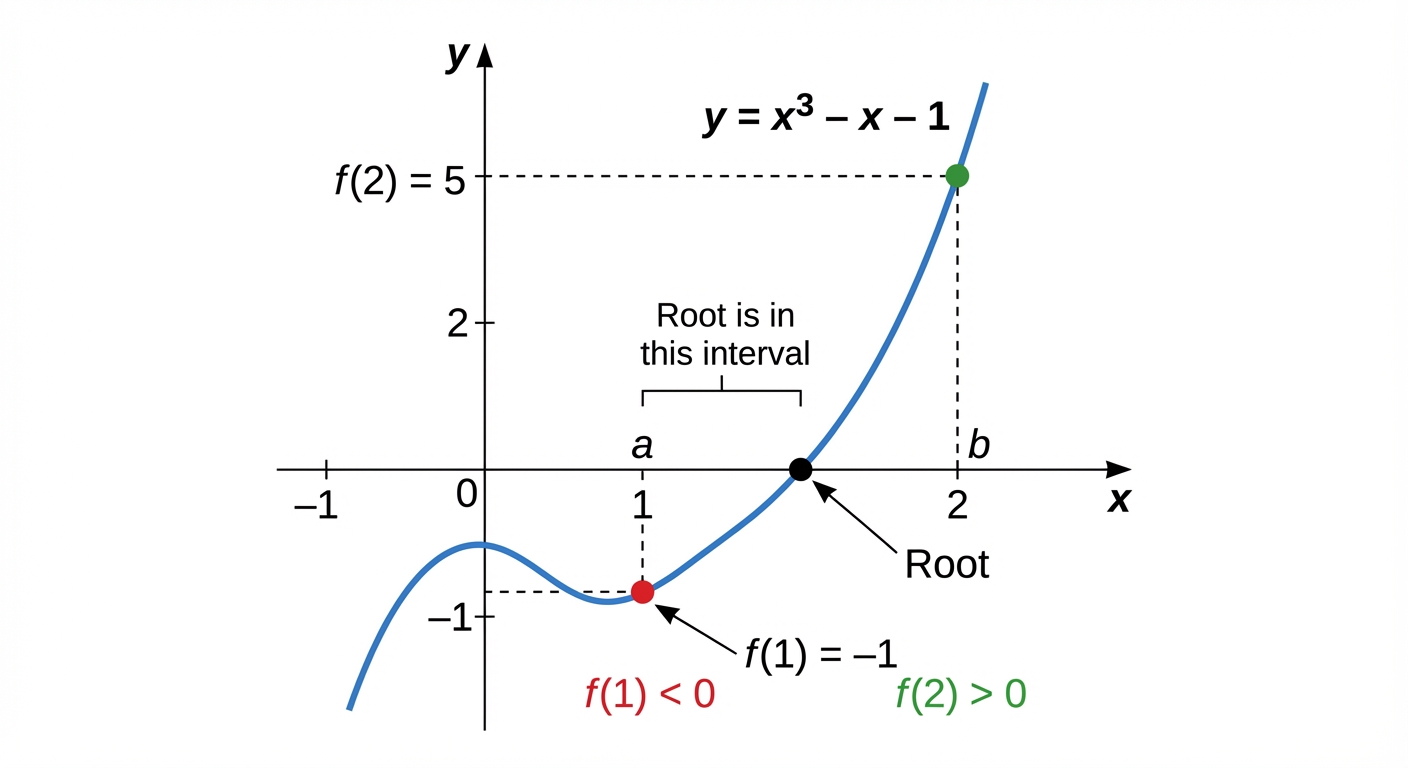 Why? Because to get from a point below the x-axis to a point above it, a continuous line has no choice but to cross it! Mathematically, we say if $f(a) \times f(b) < 0$, a root exists in $(a, b)$.<br><br>This concept is a classic first step in exam questions. They'll ask you to 'show a root lies in an interval' before asking you to find a more accurate approximation using methods we'll cover later. In the real world, this is fundamental for engineers finding points of equilibrium or data scientists finding optimal solutions in machine learning models. It's the starting point for zeroing in on an answer when a perfect algebraic solution isn't possible.
Worked Example: Proving the Existence of a Root2.6
Problem Show that the equation $x^3 + 2x - 5 = 0$ has a root in the interval $(1, 2)$.
Step 1 First up, we need to define our function. The equation is already in the perfect form, $f(x) = 0$. So, let's define $f(x)$ and state the crucial condition for this method to work: continuity. Polynomials are continuous everywhere, so we're good to go! Let $f(x) = x^3 + 2x - 5$.<br>The function $f(x)$ is a polynomial and is therefore continuous for all real values of $x$.
Step 2 Now, we test the lower bound of the interval, $x=1$. We substitute this value into our function and see if the result is positive or negative. $$f(1) = (1)^3 + 2(1) - 5 = 1 + 2 - 5 = -2$$
Step 3 Next, we do the same for the upper bound of the interval, $x=2$. We're hoping for a sign that's opposite to what we got for $f(1)$. Fingers crossed! $$f(2) = (2)^3 + 2(2) - 5 = 8 + 4 - 5 = 7$$
Step 4 This is the all-important conclusion. We've found that $f(1)$ is negative and $f(2)$ is positive. We must state this clearly and link it back to the continuity of the function to lock in the marks. This is the 'mic drop' moment of your proof. Since $f(x)$ is continuous, and there is a change of sign from $f(1) = -2$ (negative) to $f(2) = 7$ (positive), there must be at least one root in the interval $(1, 2)$.
Iterative Methods for Root Approximation2.6
Alright, so you know how some equations are just impossible to solve perfectly with regular algebra? Think of something gnarly like $x^3 + \ln(x) = 5$. There's no clean way to get 'x = ...'. This is where iterative methods come in. It's basically a 'guess and improve' strategy, like trying to find the perfect sensitivity in a game. You make a guess, see how it feels, and then make a tiny adjustment until it's just right.<br><br>First, we need to rearrange our original equation, $f(x) = 0$, into the form $x = g(x)$. For example, $x^3 + x - 5 = 0$ could be rearranged to $x = 5 - x^3$ or $x = \sqrt[3]{5-x}$. The goal is to create an iterative formula: $$x_{n+1} = g(x_n)$$ This formula is our 'improvement' rule. It says that our next guess ($x_{n+1}$) is found by plugging our current guess ($x_n$) into our rearranged function, $g(x)$.<br><br>We start with an initial guess, $x_0$, which we usually find using the sign-change method you learned about earlier. Then, we just rinse and repeat: plug in $x_0$ to get $x_1$, plug in $x_1$ to get $x_2$, and so on. If we chose a good rearrangement, these values will get closer and closer to the actual root. This is called convergence. It's like your Spotify algorithm getting better and better at recommending absolute bangers. The values home in on the true answer. 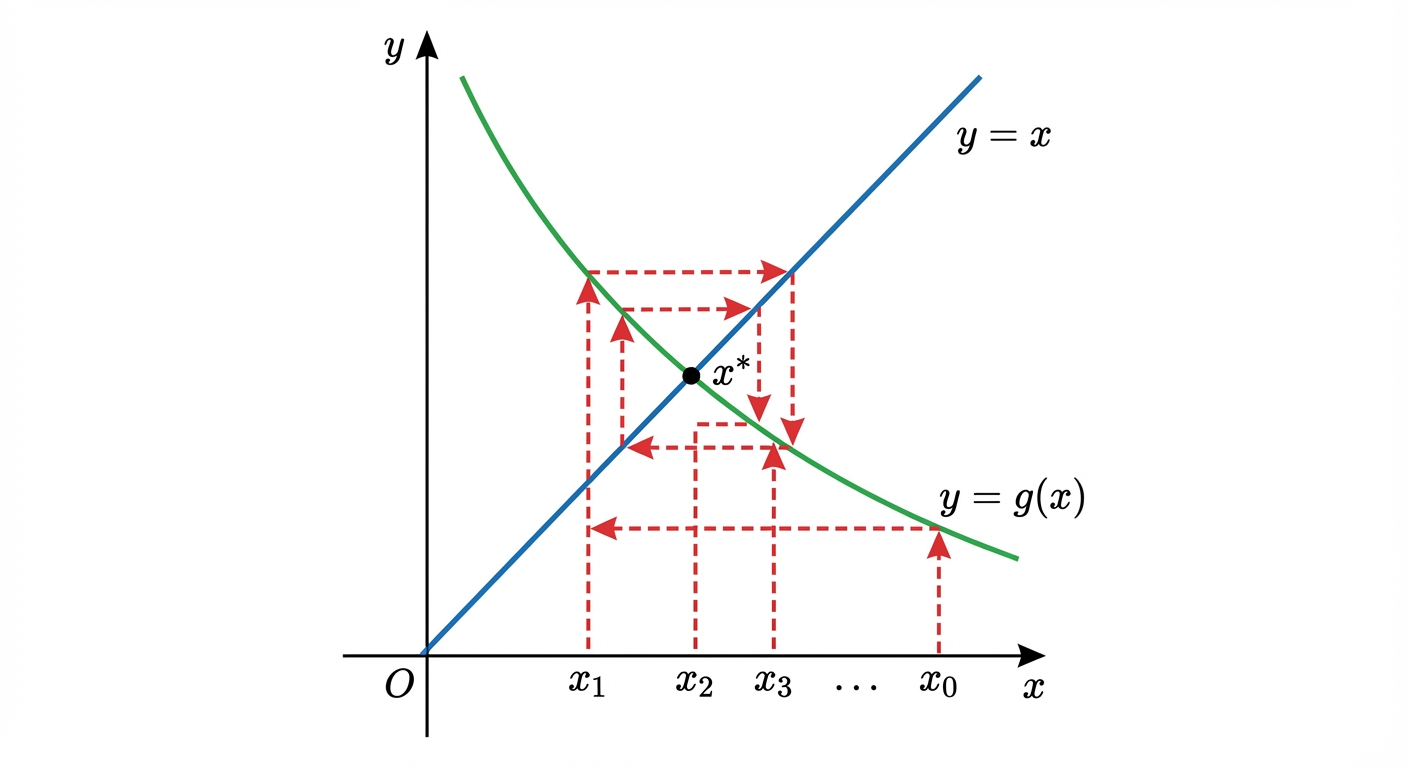 <br><br>But watch out! Sometimes, the values can fly off in the opposite direction, getting further from the root with every step. That's divergence, and it means we picked a bad rearrangement. It's like trying to correct your steering when you're learning to drive and accidentally swerving even more. The final part is knowing when to stop. The question will ask for a certain accuracy, like '3 decimal places'. You keep iterating until your answers stop changing to that degree of accuracy. When two consecutive results ($x_7$ and $x_8$, for example) round to the same number, you've found your root! 🎉
Worked Example: Applying an Iterative Formula2.6
Problem The equation $x^3 + 2x - 6 = 0$ has a single real root.<br>a) Show that the root lies between $x=1$ and $x=2$.<br>b) Use the iterative formula $x_{n+1} = \sqrt[3]{6 - 2x_n}$ with a starting value of $x_0 = 1.5$ to find the root correct to 3 decimal places. Give the result of each iteration to 5 decimal places.
Step 1 First, let's quickly do part (a) to confirm we're hunting in the right area. We define $f(x) = x^3 + 2x - 6$ and check the sign at $x=1$ and $x=2$. For $x=1$: $f(1) = 1^3 + 2(1) - 6 = 1 + 2 - 6 = -3$<br>For $x=2$: $f(2) = 2^3 + 2(2) - 6 = 8 + 4 - 6 = +6$<br>Since there is a change of sign from negative to positive, a root must lie between 1 and 2. Boom.
Step 2 Now for the main event. We're given the starting value $x_0 = 1.5$. We'll plug this into our iterative formula $x_{n+1} = \sqrt[3]{6 - 2x_n}$ to get our next value, $x_1$. A pro tip is to use your calculator's 'ANS' button to make this super fast. $$x_1 = \sqrt[3]{6 - 2x_0} = \sqrt[3]{6 - 2(1.5)} = \sqrt[3]{3} \approx 1.44225$$
Step 3 Awesome. Now we take that result for $x_1$ and plug it back into the formula to find $x_2$. If you're using the ANS button, you just have to press the '=' key again! $$x_2 = \sqrt[3]{6 - 2x_1} = \sqrt[3]{6 - 2(1.44225)} = \sqrt[3]{3.1155} \approx 1.46042$$
Step 4 Let's keep the chain going. We repeat the process, feeding our new answer back in each time. We're looking for the numbers to stabilize. $$x_3 = \sqrt[3]{6 - 2(1.46042)} \approx 1.45421$$<br>$$x_4 = \sqrt[3]{6 - 2(1.45421)} \approx 1.45636$$<br>$$x_5 = \sqrt[3]{6 - 2(1.45636)} \approx 1.45561$$<br>$$x_6 = \sqrt[3]{6 - 2(1.45561)} \approx 1.45587$$
Step 5 Let's do a couple more to be sure. We need the answer correct to 3 decimal places, so we should wait until the first 4 or 5 decimal places stop changing. $$x_7 = \sqrt[3]{6 - 2(1.45587)} \approx 1.45578$$<br>$$x_8 = \sqrt[3]{6 - 2(1.45578)} \approx 1.45581$$<br>$$x_9 = \sqrt[3]{6 - 2(1.45581)} \approx 1.45580$$
Step 6 Okay, look at $x_8$ and $x_9$. They are $1.45581$ and $1.45580$. If we round these to 3 decimal places, they both become $1.456$. Since the value has stabilized, we can confidently state our final answer. The root is $x = 1.456$ (correct to 3 d.p.)
Key Points to Remember
- Locating Roots: If a continuous function $f(x)$ changes sign between $x=a$ and $x=b$, meaning $f(a)$ and $f(b)$ have opposite signs, then there must be at least one root in the interval $(a, b)$.
- Iteration: An iterative formula, like $x_{n+1} = g(x_n)$, uses a starting value $x_0$ to generate a sequence of values ($x_1, x_2, x_3, ...$) that hopefully converge to the actual root of an equation.