Introduction
Alright, welcome to the core of Mechanics! This chapter is all about understanding why things move the way they do. We're going to dive deep into one of the most famous equations in all of physics: Newton's Second Law, or as you'll come to know it, your new best friend, $F=ma$. We'll start there, figuring out how forces create acceleration. Then, we'll take that knowledge and literally put it on a slant by tackling motion on inclined planes – think boxes sliding down ramps. Finally, we'll level up by looking at connected particles, systems where objects are tied together by strings and pulleys. By the end of this, you'll be able to model and solve some seriously cool real-world motion problems. Let's get into it! 💪
Newton's Second Law of Motion: The Relationship Between Force, Mass, and Acceleration4.4
Alright, let's break down the absolute cornerstone of mechanics: Newton's Second Law. You've seen $F=ma$ everywhere, but in A-Level, we treat it with the respect it deserves. The key thing to burn into your brain is that 'F' isn't just any force; it's the resultant or net force acting on the particle. Think of it as the final outcome of a multi-way tug-of-war. If the forces are balanced, the net force is zero, and the object either stays still or moves at a constant velocity (that's Newton's First Law giving us a wave 👋). But if there's an unbalanced force, the object accelerates. This law connects force (the cause), mass (the object's inertia or 'reluctance to move'), and acceleration (the effect). We'll be applying this to particles under various constant forces. You'll encounter:<br>- Weight ($W=mg$): The non-negotiable downward pull of gravity. $g$ is your constant, usually $9.8$ or $10 \, \text{ms}^{-2}$.<br>- Tension (T): The pulling force in a string or cable. It always acts along the string, pulling away from the object.<br>- Thrust: A pushing force, like from a rocket engine or a rigid rod.<br>- Friction ($F_r$): The resistive force that always opposes motion or intended motion. We model it with $F_r \le \mu R$, where $R$ is the normal reaction force (the surface pushing back). 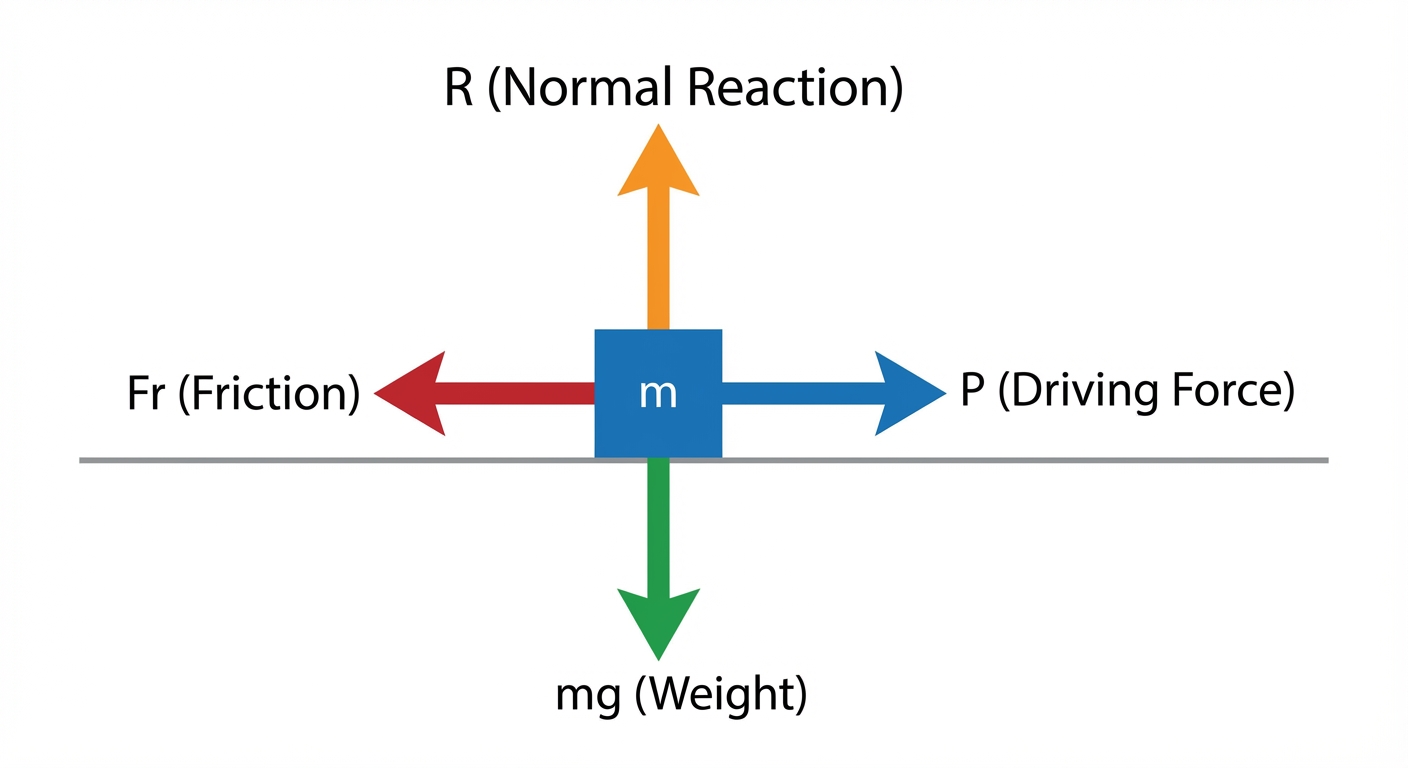 <br>Mastering this isn't just about passing M1; it's fundamental for any STEM degree, especially engineering or physics. You're literally learning the principles that govern how bridges stay up and how satellites stay in orbit. So, when you're setting up your equations, always start by identifying all the forces, find the resultant force in the direction of acceleration, and then unleash $F_{net}=ma$.
Worked Example: Application of Newton's Second Law with Friction4.4
Problem A box of mass $10 \, \text{kg}$ is pulled along a rough horizontal floor by a constant horizontal force of $50 \, \text{N}$. The coefficient of friction between the box and the floor is $0.2$. Calculate the acceleration of the box. (Take $g = 9.8 \, \text{ms}^{-2}$).
Step 1 First things first, let's get a visual. A free-body diagram is non-negotiable in Mechanics – it helps us see all the forces in play. We have the pulling force ($50 \, \text{N}$) to the right, friction ($F_r$) to the left, weight ($W=mg$) acting down, and the normal reaction ($R$) acting up. Image a box with four arrows originating from the center: $R$ (up), $W$ (down), $50 \, \text{N}$ (right), $F_r$ (left).
Step 2 The box isn't accelerating vertically (it's not flying or sinking!), so the vertical forces must be balanced. This allows us to find the normal reaction force, $R$, which is crucial for calculating friction. $$\text{Resolving vertically (}\uparrow\text{): } R - W = 0 \implies R = W = mg \\ R = 10 \times 9.8 = 98 \, \text{N}$$
Step 3 Since the box is moving, friction is at its maximum value, given by the formula $F_{max} = \mu R$. This force opposes the $50 \, \text{N}$ pull. $$F_{max} = \mu R = 0.2 \times 98 = 19.6 \, \text{N}$$
Step 4 This is the main event! We apply Newton's Second Law, $F_{net} = ma$, in the direction of motion (horizontally). The net force is the driving force minus the resistive force (friction). $$\text{Resolving horizontally (}\rightarrow\text{): } F_{net} = ma \\ 50 - F_{max} = 10a \\ 50 - 19.6 = 10a$$
Step 5 Just a little bit of algebra to isolate 'a' and we've got our answer. Don't forget the units! $$30.4 = 10a \\ a = \frac{30.4}{10} = 3.04 \, \text{ms}^{-2}$$
Resolving Forces on Inclined Planes4.4
Alright, let's tackle inclined planes. Think of any scenario with a slope: a skier on a mountain, a car driving up a hill, or even just you sliding down a grassy bank. In mechanics, these are all 'inclined plane' problems. The absolute game-changer here is to tilt your perspective. Instead of thinking in terms of standard horizontal (x) and vertical (y) axes, we align our axes with the slope. Why? Because the object's acceleration (if any) and the normal reaction force are almost always parallel or perpendicular to the slope. This makes the maths way cleaner. <br><br> The first and most crucial step is to deal with the weight, $W = mg$, which always acts vertically downwards. Since our axes are tilted, we have to resolve this weight vector into two components. 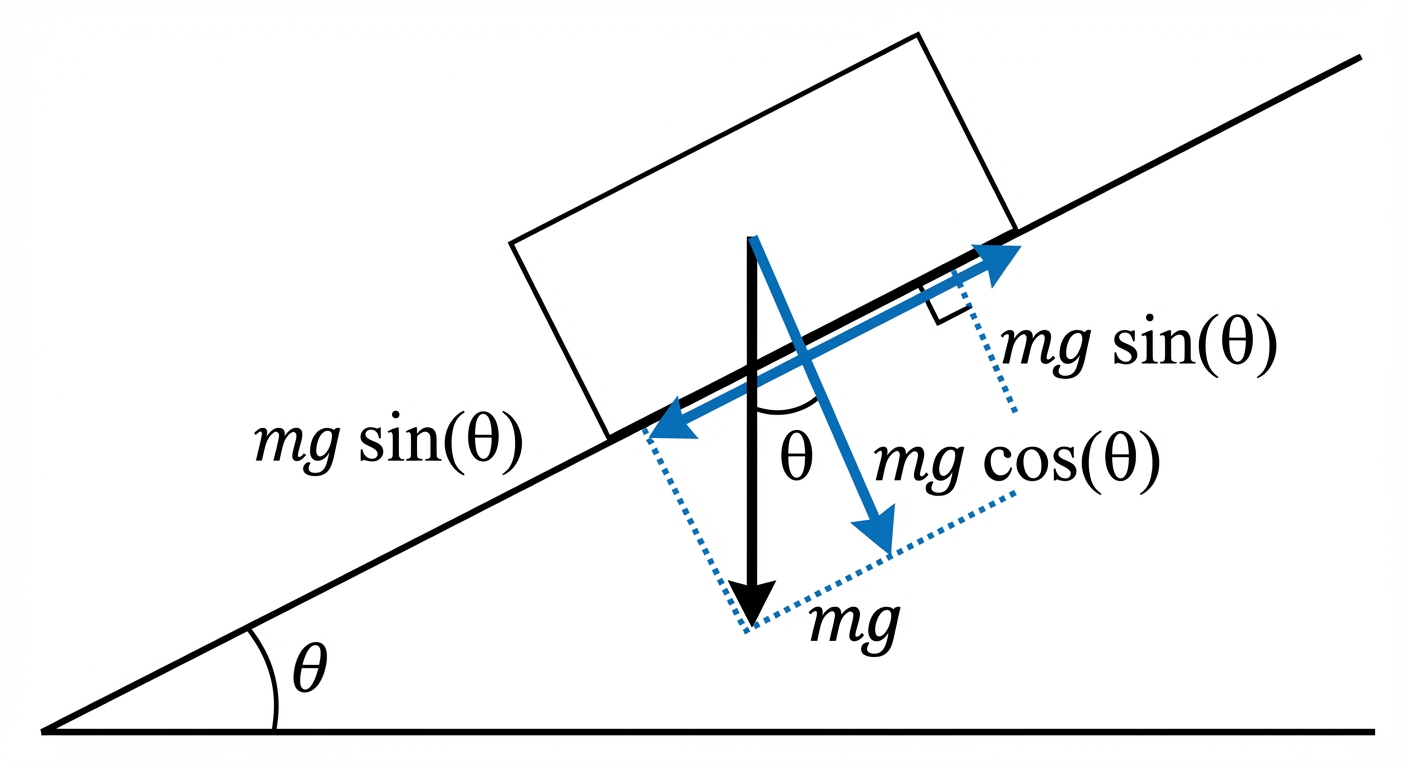 The component pushing the object into the plane is $mg \cos(\theta)$. This is balanced by the normal reaction force, $R$, so we get the vital equation $R = mg \cos(\theta)$. The component pulling the object down the slope is $mg \sin(\theta)$. Think of this as the 'sliding force' provided by gravity. <br><br> Now, let's add friction. Friction, $F_r$, is the ultimate party pooper – it always opposes motion or intended motion. Its maximum value is calculated by $F_{max} = \mu R$, where $\mu$ is the coefficient of friction. By substituting our expression for $R$, we find that $F_{max} = \mu mg \cos(\theta)$. To solve any problem, you'll apply Newton's Laws along your new tilted axes. Perpendicular to the plane, forces are almost always balanced ($R = mg \cos(\theta)$). Parallel to the plane, you'll use $F_{net} = ma$. You'll sum up all the forces pushing the object up the slope and subtract all the forces pulling it down (like $mg \sin(\theta)$ and friction), and set the result equal to $ma$. Mastering this skill is not just about passing your exam; it's fundamental for any future in engineering or physics, from designing safe roads to analyzing the forces on a rocket during launch. You've got this! 💪
Worked Example: Dynamics of a Particle on a Rough Inclined Plane4.4
Problem A box of mass 10 kg rests on a rough plane inclined at an angle of 30° to the horizontal. The coefficient of friction between the box and the plane is 0.2. A constant force, $P$, of 120 N is applied to the box, acting parallel to the plane and pushing it upwards. Taking $g = 9.8 \text{ m s}^{-2}$, find the acceleration of the box up the plane.
Step 1 First things first, let's get our head straight by drawing a clear force diagram and resolving the weight. The key forces are the applied force ($P$), weight ($mg$), normal reaction ($R$), and friction ($F_r$). We'll resolve the weight into components parallel and perpendicular to the plane. $$ \text{Component of weight parallel to plane} = mg \sin(30°) $$<br>$$ \text{Component of weight perpendicular to plane} = mg \cos(30°) $$
Step 2 Now, we resolve forces perpendicular to the plane. Since the box isn't flying off or burrowing into the slope, the net force in this direction is zero. This allows us to find the normal reaction force, $R$, which we'll need to calculate friction. $$ R - mg \cos(30°) = 0 \implies R = mg \cos(30°) $$<br>$$ R = (10)(9.8) \cos(30°) = 98 \times \frac{\sqrt{3}}{2} \approx 84.87 \text{ N} $$
Step 3 With the value for $R$, we can find the maximum frictional force. Since the box is being pushed up the slope, friction will act down the slope, opposing the motion. We assume the box is moving, so friction is at its maximum value, $F_r = \mu R$. $$ F_r = \mu R = 0.2 \times 84.87 \approx 16.97 \text{ N} $$
Step 4 This is the main event! We apply Newton's Second Law, $F_{net} = ma$, parallel to the plane. We define the positive direction as 'up the plane'. The net force is the driving force ($P$) minus the resistive forces (the parallel component of weight and friction). $$ F_{net} = P - (mg \sin(30°) + F_r) = ma $$
Step 5 Finally, we substitute all our known values into the equation and solve for the acceleration, $a$. Let's crunch the numbers. $$ 120 - ((10)(9.8) \sin(30°) + 16.97) = 10a $$<br>$$ 120 - (49 + 16.97) = 10a $$<br>$$ 120 - 65.97 = 10a $$<br>$$ 54.03 = 10a $$<br>$$ a = 5.403 \text{ m s}^{-2} $$<br>So, the acceleration of the box up the plane is approximately $5.40 \text{ m s}^{-2}$ (3 s.f.).
Analysis of Connected Particle Systems4.4
Alright, let's talk about connected particles. This is a huge concept in M1 and a classic exam question. Think of it like a three-legged race or a car towing a trailer – two objects moving together, influencing each other. The key is that because they are connected (by a 'light inextensible string' or a 'tow-bar'), they move as a single system. This means they share the same magnitude of acceleration. <br><br>The game-changing strategy here is a two-step attack: <br>1. Analyse the WHOLE system first. Imagine shrink-wrapping the two particles and the connection into one giant blob. Now, apply Newton's Second Law, $F_{net} = m_{total}a$. The genius part? The forces inside the system, like the tension in the string or tow-bar, are internal forces. They pull equally and oppositely on each particle (Newton's Third Law, what's up!), so they cancel each other out when you look at the whole system. You only need to consider the external forces – like gravity, driving forces, or friction. This almost always lets you find the system's acceleration, $a$. 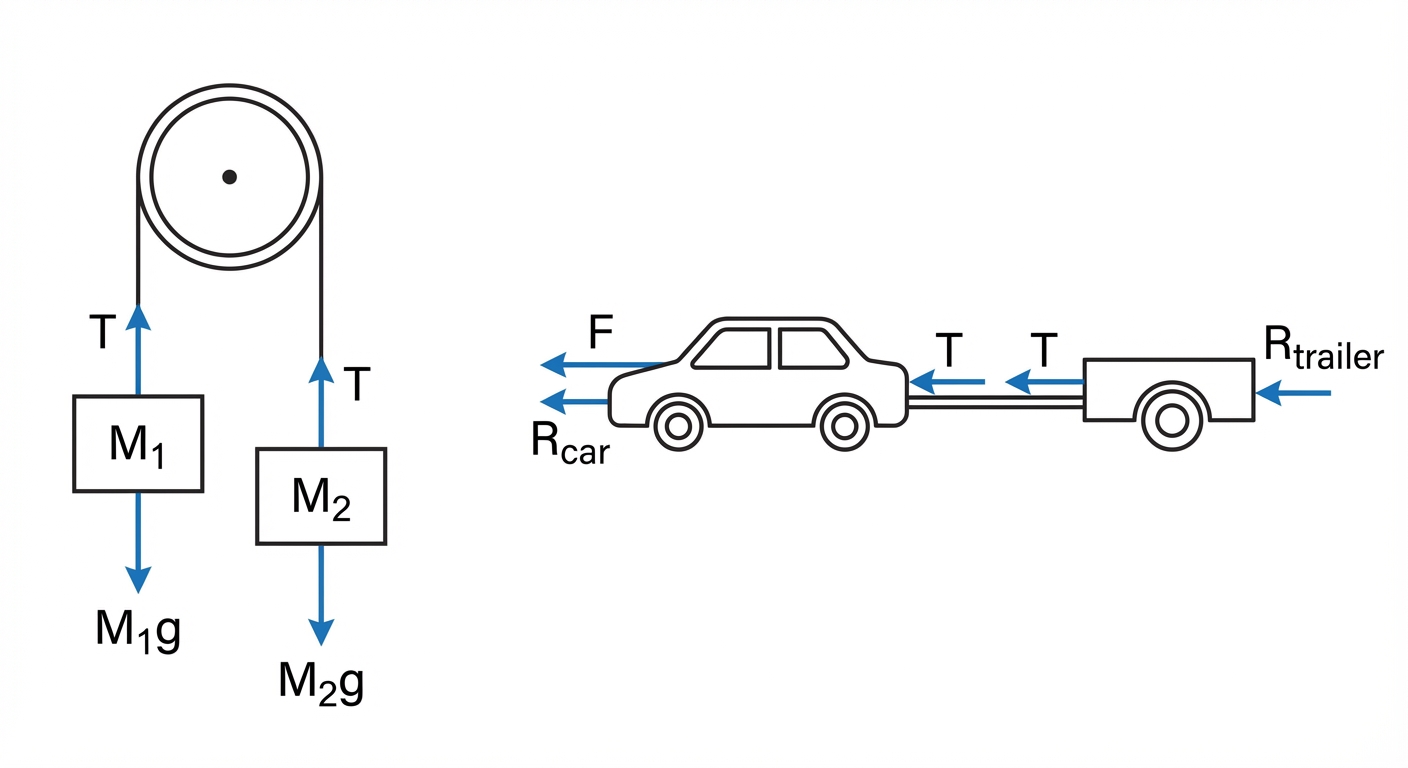 <br>2. ISOLATE one particle. Once you have the acceleration, you 'zoom in' on just one of the particles. Draw its free-body diagram. Now, that internal force (like tension, $T$) becomes an external force acting on your isolated particle. Apply $F_{net} = ma$ to this single particle, using the acceleration you just found, and you can solve for the tension or any other unknown force. Remember the assumptions: 'light inextensible string' means the mass of the string is zero and the tension is uniform throughout. A 'smooth pulley' means there's no friction at the pulley, so tension is the same on both sides. Mastering this two-step process is crucial for university-level physics and engineering, where you'll analyse much more complex systems.
Worked Example: Pulley System Dynamics4.4
Problem Two particles, A and B, have masses of 5 kg and 3 kg respectively. They are connected by a light inextensible string which passes over a smooth, fixed pulley. The system is held at rest with the string taut and then released. Find the acceleration of the system and the tension in the string. (Assume $g = 9.8 \text{ m s}^{-2}$)
Step 1 First, let's treat both particles as a single system to find the overall acceleration, $a$. The heavier mass (A) will accelerate downwards, and the lighter mass (B) will accelerate upwards. The driving force is the weight of A ($5g$), and the opposing force is the weight of B ($3g$). The tension is internal, so we ignore it for the system-wide calculation. $$ F_{net} = m_{total}a $$ $$ 5g - 3g = (5+3)a $$
Step 2 Now we simply solve the equation from Step 1 for $a$. This gives us the magnitude of acceleration for both particles. $$ 2g = 8a $$ $$ a = \frac{2g}{8} = \frac{g}{4} = \frac{9.8}{4} = 2.45 \text{ m s}^{-2} $$
Step 3 To find the tension ($T$), we must isolate one particle. Let's analyse particle B (3 kg). It's accelerating upwards. The forces acting on it are tension ($T$) pulling up and its weight ($3g$) pulling down. The net force is therefore $T - 3g$. $$ F_{net} = m_B a $$ $$ T - 3g = 3a $$
Step 4 Finally, substitute our value for $a$ into the equation for particle B to solve for $T$. This is a classic exam technique to get the final marks. $$ T = 3a + 3g $$ $$ T = 3(2.45) + 3(9.8) = 7.35 + 29.4 $$ $$ T = 36.75 \text{ N} $$
Step 5 Exam Check: Let's quickly verify this by isolating particle A (5 kg), which accelerates downwards. The net force is its weight minus tension. If we get the same $T$, we know we're correct. $$ 5g - T = 5a $$ $$ T = 5g - 5a = 5(9.8) - 5(2.45) $$ $$ T = 49 - 12.25 = 36.75 \text{ N} $$ It matches! Perfect. ✅
Key Points to Remember
- Newton's Second Law: The golden rule is that the resultant force acting on an object is equal to its mass times its acceleration ($$\Sigma F = ma$$). Always draw a force diagram and resolve forces in the direction of motion!
- Inclined Planes: When an object is on a slope, always resolve the weight ($mg$) into components parallel ($mg \sin \theta$) and perpendicular ($mg \cos \theta$) to the plane. This is the key to solving for motion and the normal reaction force.
- Connected Particles: Treat the system as a single object to find the common acceleration. To find the tension in the string, isolate one of the particles and apply $F=ma$ just to that particle. Remember, tension is an internal force that pulls equally on both ends.