Introduction
Alright, let's talk motion, forces and energy. Every time you check your run pace on a fitness app, feel yourself pressed back into a seat when a car pulls away, or watch a phone slide off a tilted table, you're living this chapter in real time. This is your five-minute refresh on measuring stuff, speed and acceleration, forces and Newton's second law, moments, energy, work, power, and pressure. Almost every Core paper leans on these ideas, and most marks come down to one clean equation plus one clear sentence. Let's get moving! 🏎️
Measuring Length, Volume and Time1.1
Physics starts with good measurements. Use a ruler for length, a measuring cylinder for liquid volume (read the bottom of the curved surface, the meniscus, at eye level), and a clock or stopwatch for time. The pro move for accuracy is measuring many and dividing: stack 100 sheets of paper and divide the height by 100 to get one sheet's thickness, or time 20 swings of a pendulum and divide by 20 to get one period. This shrinks the effect of your reaction-time and reading errors.
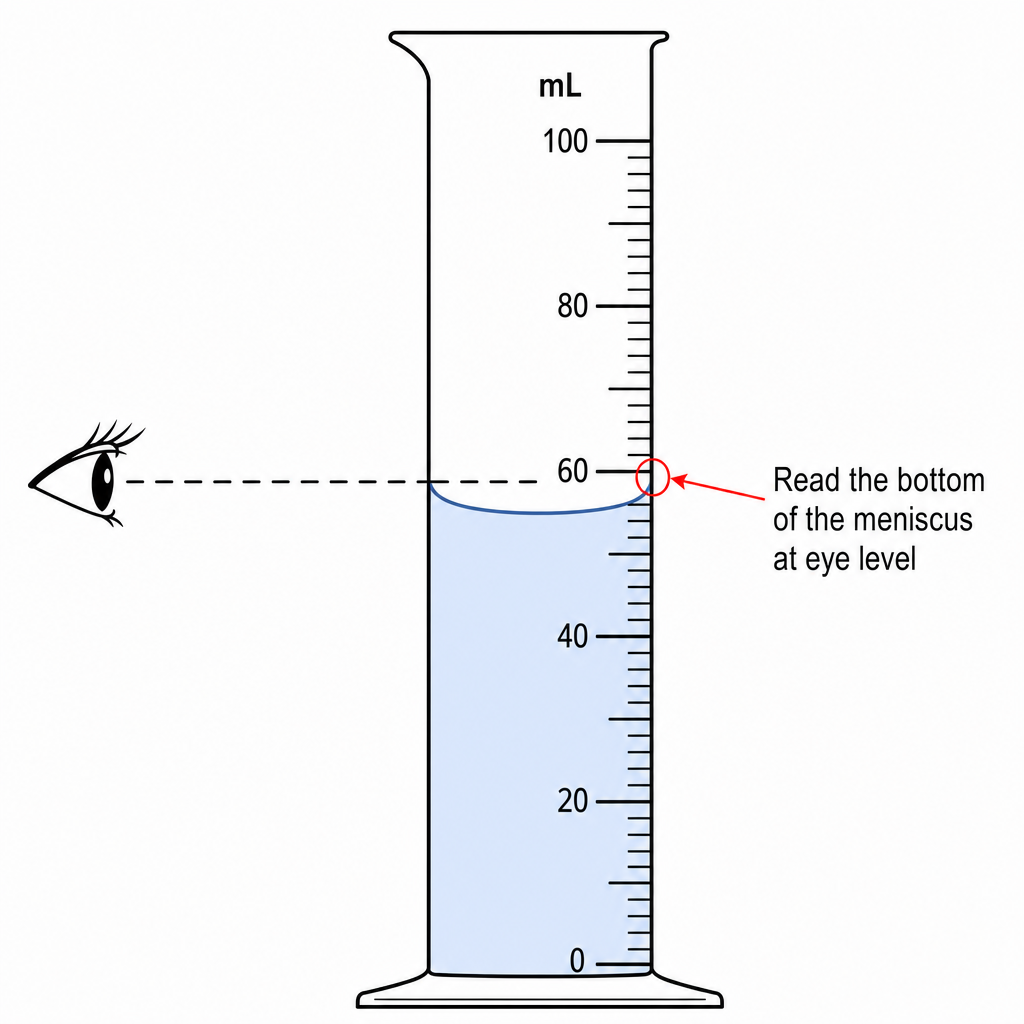
> 🔑 Key idea: Measure many and divide for thin or fast things (100 sheets, 20 swings). Read a meniscus at eye level.
Worked Example: Thickness of One Sheet of Paper1.1
Problem A stack of $500$ sheets of paper is $50$ mm tall. Find the thickness of one sheet, and explain why measuring the whole stack is more accurate than measuring one sheet.
Step 1 Divide the total height by the number of sheets: $50 \div 500 = 0.1$ mm per sheet. Measuring one sheet directly would be swamped by the ruler's $\pm 1$ mm reading error; spreading that error over 500 sheets makes it tiny per sheet.
Speed, Velocity and Acceleration1.2
Speed is how fast you cover ground: $\text{speed} = \dfrac{\text{distance}}{\text{time}}$, in m/s. Velocity is speed with a direction. Acceleration is how quickly velocity changes: $a = \dfrac{\Delta v}{t}$, in m/s². On a distance–time graph the gradient is the speed (flat = stopped). On a speed–time graph the gradient is the acceleration and the area underneath is the distance travelled. Near Earth, falling objects accelerate at $g \approx 9.8$ m/s² (use $9.8$ or $10$). A falling object reaches terminal velocity when air resistance grows to balance its weight, so the resultant force is zero and it stops speeding up. 🪂
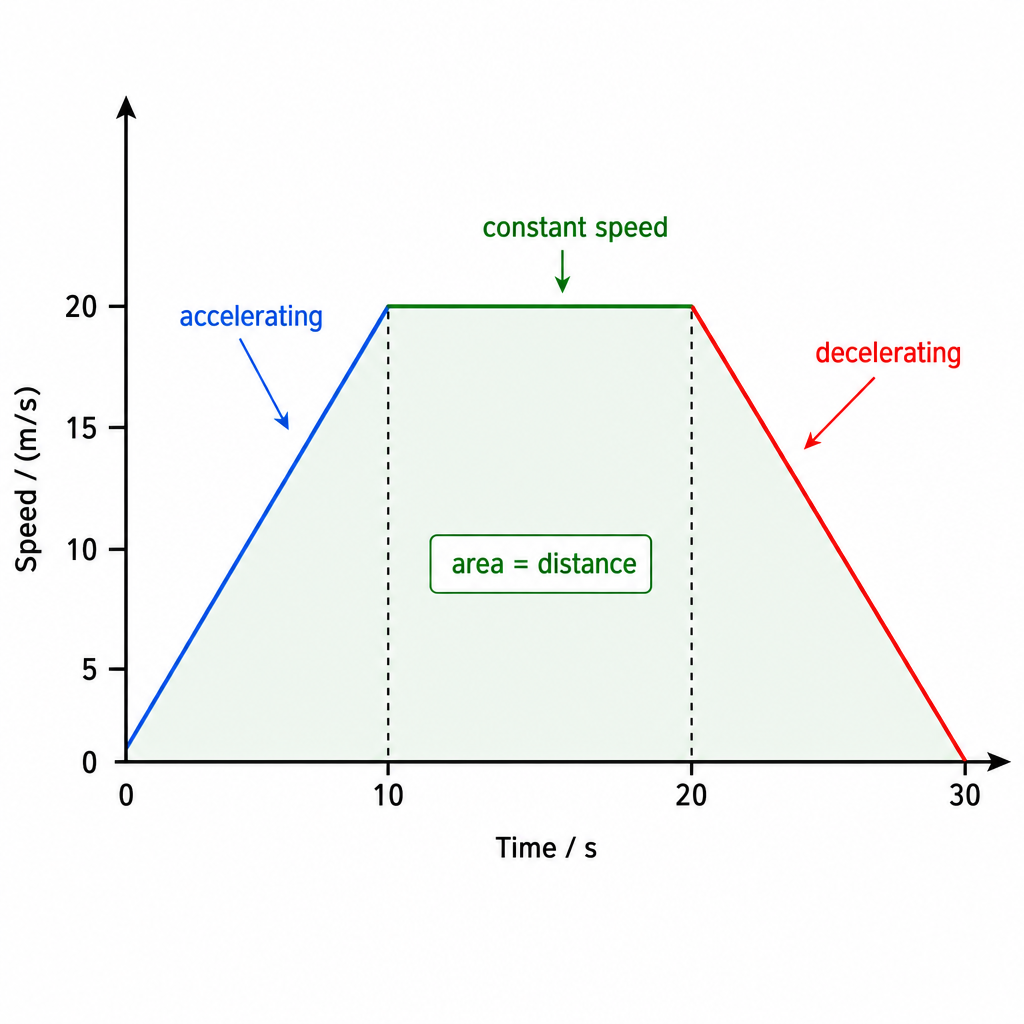
> 🔑 Key formula: $\text{speed}=\dfrac{d}{t}$, $a=\dfrac{\Delta v}{t}$. Speed–time gradient = acceleration; area under it = distance.
Worked Example: Reading a Speed–Time Graph1.2
Problem A bus speeds up from rest to $20$ m/s in $10$ s, holds $20$ m/s for the next $10$ s, then brakes to a stop over $5$ s. Find its acceleration during the first stage and the distance covered while at constant speed.
Step 1 Acceleration in the first stage is the gradient: $a = \dfrac{\Delta v}{t} = \dfrac{20 - 0}{10} = 2.0$ m/s².
Step 2 Distance at constant speed is the area of that rectangle on the graph: $d = \text{speed} \times \text{time} = 20 \times 10 = 200$ m.
Step 3 Sanity-check: $200$ m in $10$ s at $20$ m/s is exactly right, and the units work ($\text{m/s} \times \text{s} = \text{m}$). Reading area-under-the-graph is worth easy marks every paper.
Mass, Weight and Gravitational Field Strength1.3
Mass is the amount of matter in something, measured in kilograms, and it's the same everywhere in the universe. Weight is the downward pull of gravity on that mass, a force in newtons: $W = mg$, where $g$ is the gravitational field strength, about $9.8$ N/kg on Earth. On the Moon $g$ is only about $1.6$ N/kg, so your weight is far less even though your mass hasn't budged. Rearranged, $g = \dfrac{W}{m}$ lets you find the field strength from a measured weight.
> 🔑 Key formula: $W = mg$ ($g \approx 9.8$ N/kg on Earth). Mass (kg) is fixed; weight (N) depends on $g$.
Worked Example: Weight on Earth1.3
Problem A student has a mass of $60$ kg. Find their weight on Earth, where $g = 9.8$ N/kg.
Step 1 Apply $W = mg = 60 \times 9.8 = 588$ N. Mass stays $60$ kg anywhere; only the weight changes if $g$ changes (it would be about $96$ N on the Moon).
Density and Floating1.4
Density is how much mass is packed into a volume: $\rho = \dfrac{m}{V}$, in kg/m³ or g/cm³. Find a regular solid's volume from its dimensions; find an irregular solid's volume from the water it displaces in a measuring cylinder. The floating rule is simple: an object floats if it is less dense than the liquid, and sinks if it is more dense. Ice floats because it's slightly less dense than water; a steel nail sinks because steel is far denser. A steel ship floats because its hull shape gives it a low average density (lots of trapped air).
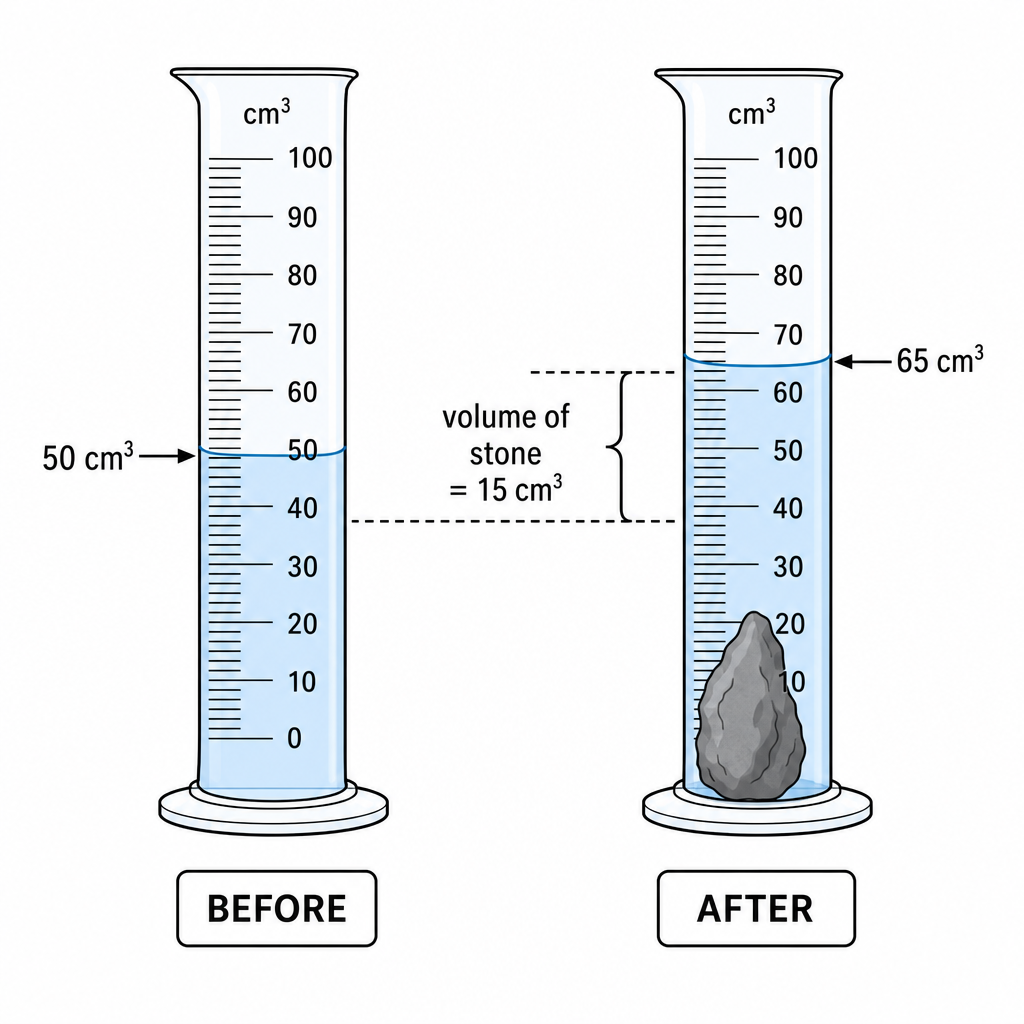
> 🔑 Key formula: $\rho = \dfrac{m}{V}$. Floats if less dense than the liquid, sinks if more dense.
Worked Example: Density of a Metal Block1.4
Problem A metal block has a mass of $240$ g and a volume of $30$ cm³. Find its density.
Step 1 Apply $\rho = \dfrac{m}{V} = \dfrac{240}{30} = 8.0$ g/cm³. Comparing to known densities (gold is $19.3$ g/cm³) tells you straight away this block is not gold.
Forces, Hooke's Law and Newton's Second Law1.5.1
A force (in newtons) can change an object's speed, direction, or shape. Add up forces along a line to get the resultant: a non-zero resultant accelerates the object in its direction, while a zero resultant means constant velocity (or rest). Newton's second law ties them together: $F = ma$. Stretching a spring follows Hooke's law: extension is proportional to load, $F = kx$, up to the limit of proportionality, beyond which the line bends. Friction and air resistance are contact forces that always oppose motion.
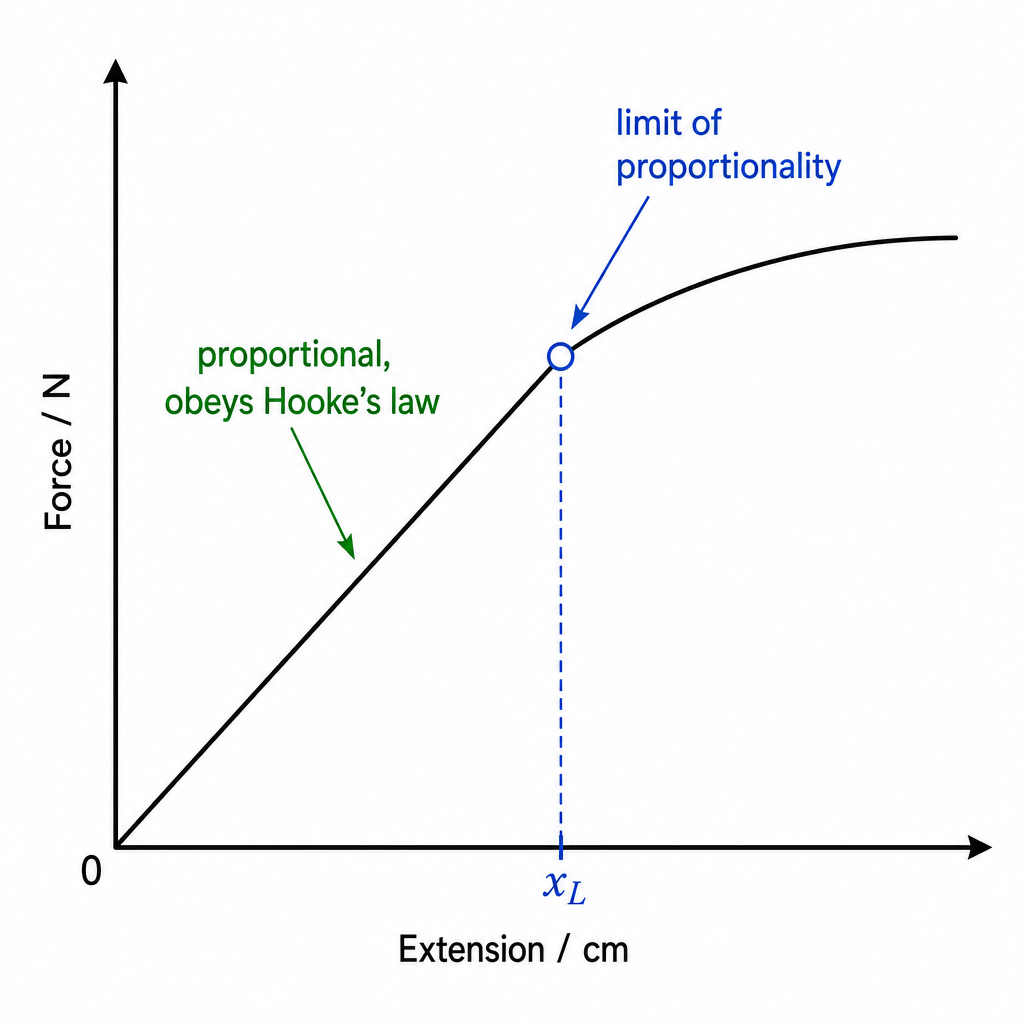
> 🔑 Key formula: $F = ma$ (resultant force). Hooke's law $F = kx$ holds up to the limit of proportionality.
Worked Example: Accelerating a Car1.5.1
Problem A car of mass $1200$ kg experiences a resultant forward force of $3600$ N. Find its acceleration.
Step 1 Write the equation and rearrange for $a$: $F = ma \Rightarrow a = \dfrac{F}{m}$.
Step 2 Substitute: $a = \dfrac{3600}{1200} = 3.0$ m/s².
Step 3 Sanity-check the units: $\dfrac{\text{N}}{\text{kg}} = \text{m/s}^2$, and $3.0$ m/s² means the car gains $3$ m/s of speed every second. Double the force (same mass) would double the acceleration.
Moments and Equilibrium1.5.2
A moment is the turning effect of a force: $\text{moment} = F \times d$, where $d$ is the perpendicular distance from the pivot, measured in N m. A long spanner gives a bigger moment for the same push because $d$ is larger. When something balances (is in equilibrium), the principle of moments applies: total clockwise moment = total anticlockwise moment about the pivot. That's how a see-saw balances and how you read a beam-balance question.
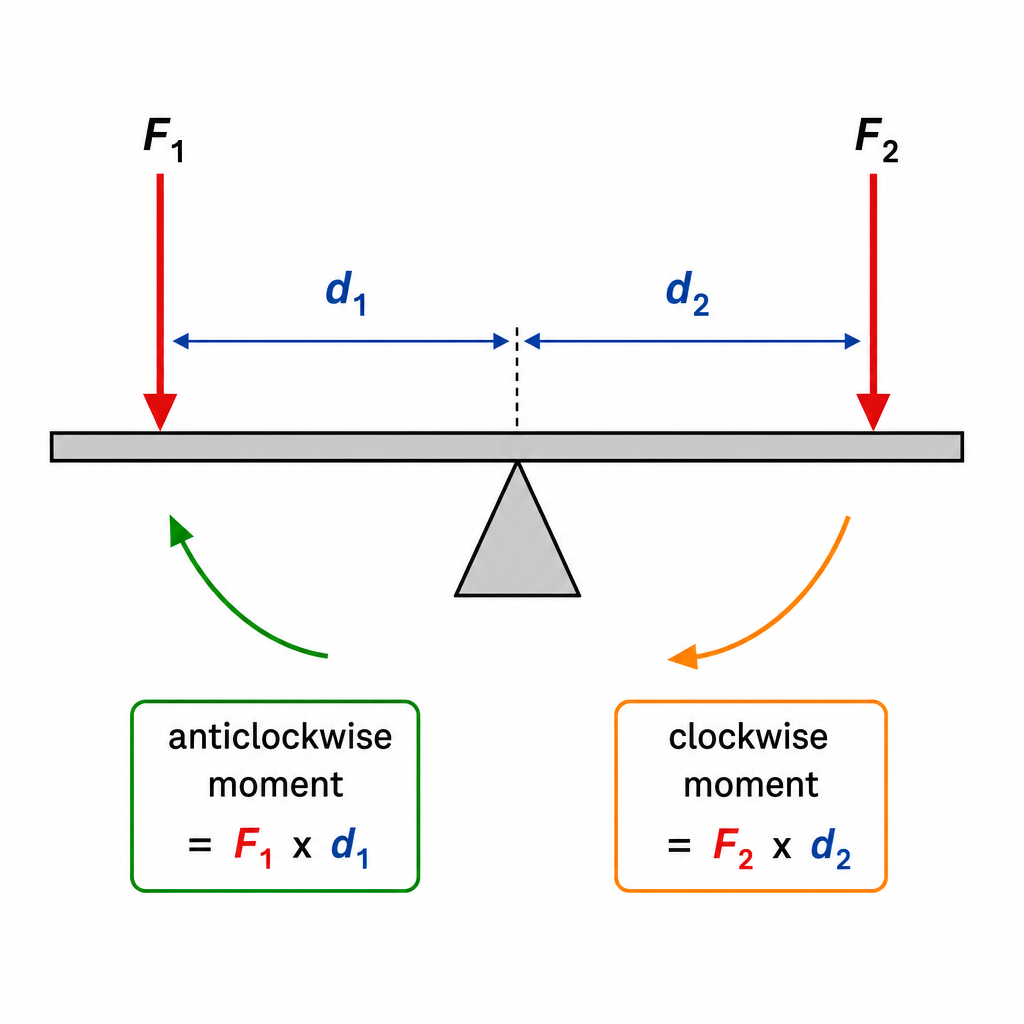
> 🔑 Key formula: Moment $= F \times d$ (perpendicular). Balanced: clockwise moments = anticlockwise moments.
Worked Example: Balancing a See-Saw1.5.2
Problem A $300$ N child sits $2.0$ m from the pivot of a see-saw. How far from the pivot must a $400$ N child sit on the other side to balance it?
Step 1 Apply the principle of moments (clockwise = anticlockwise): $300 \times 2.0 = 400 \times d$, so $d = \dfrac{600}{400} = 1.5$ m. The heavier child sits closer, exactly as a real see-saw works.
Centre of Gravity and Stability1.5.3
The centre of gravity is the single point where an object's whole weight seems to act. An object is stable and resists toppling when it has a low centre of gravity and a wide base. It topples once its centre of gravity passes outside the edge of its base, because the weight then produces a turning moment that tips it over. That's why racing cars are low and wide, why a tall bus is more likely to tip than a sports car, and why you widen your stance on a moving train.
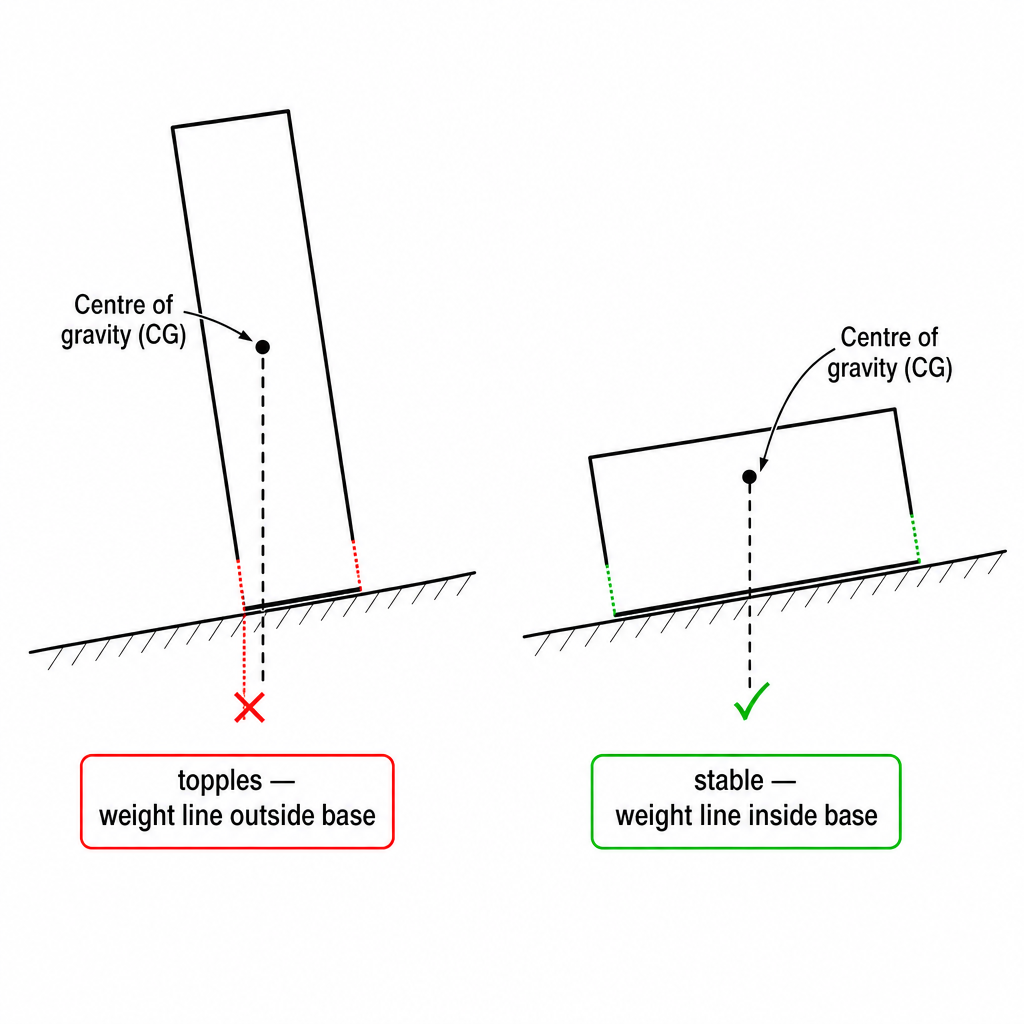
> 🔑 Key idea: Low centre of gravity + wide base = stable. Topples when the weight line falls outside the base.
Worked Example: Which Box Tips First1.5.3
Problem Two boxes of equal weight stand on a ramp that is slowly tilted: one is tall and narrow, the other low and wide. Which topples first, and why?
Step 1 The tall narrow box topples first. Its higher centre of gravity and narrower base mean the vertical line through its centre of gravity passes outside the base at a smaller tilt angle, creating a toppling moment sooner.
Energy Stores and Conservation1.7.1
Energy is stored in different ways: kinetic (movement), gravitational potential (height), chemical (food, fuel, batteries), elastic (stretched springs), and more. The big rule is conservation of energy: energy is never created or destroyed, only transferred from one store to another. Two Core equations: kinetic energy $E_k = \tfrac{1}{2}mv^2$ and the change in gravitational potential energy $\Delta E_p = mg\,\Delta h$. A falling ball converts gravitational store into kinetic store; a roller-coaster trades the two back and forth all the way round. 🎢
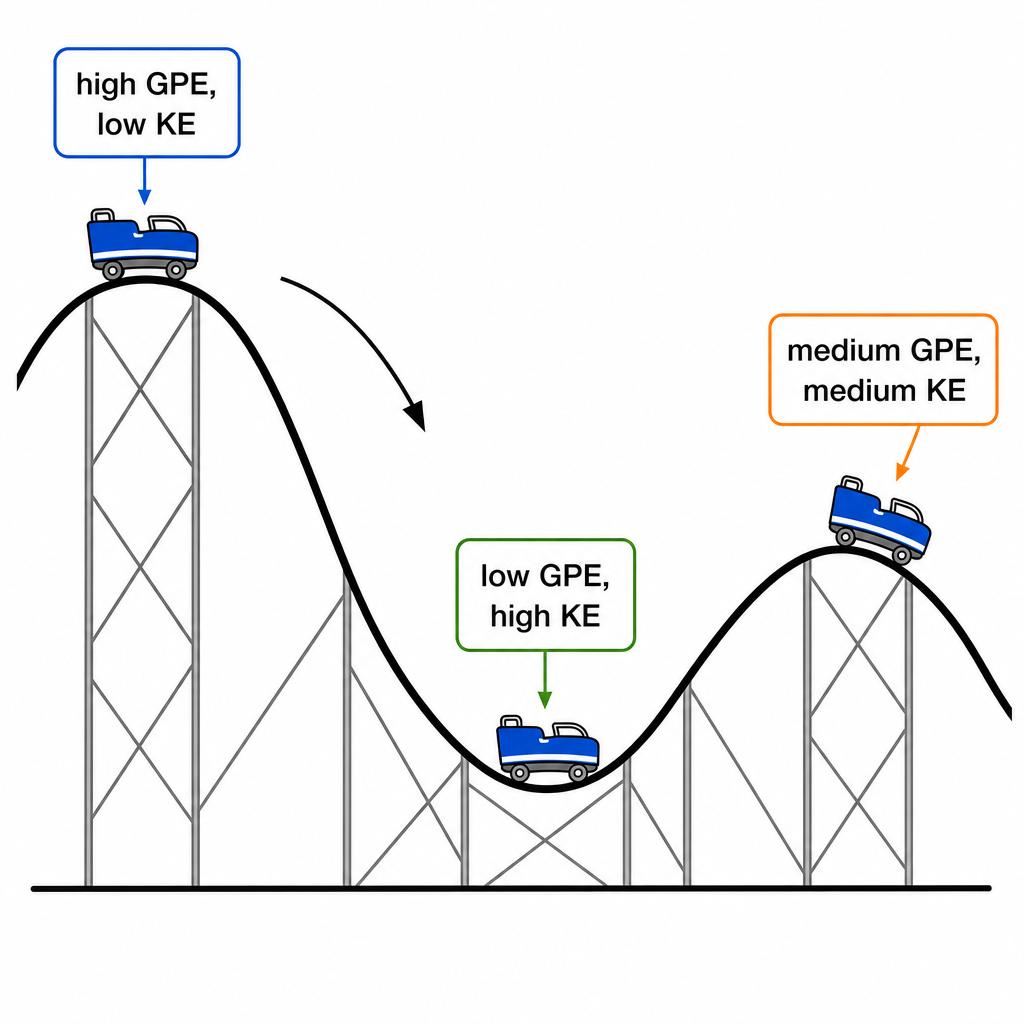
> 🔑 Key formula: $E_k = \tfrac{1}{2}mv^2$, $\Delta E_p = mg\,\Delta h$. Energy is transferred between stores, never destroyed.
Worked Example: A Falling Ball1.7.1
Problem A $0.50$ kg ball is dropped from a height of $1.8$ m. Using energy conservation, find its speed just before it lands. Take $g = 9.8$ N/kg and ignore air resistance.
Step 1 The gravitational store lost equals the kinetic store gained: $mg\,\Delta h = \tfrac{1}{2}mv^2$. The mass cancels, so $v^2 = 2g\,\Delta h = 2 \times 9.8 \times 1.8 \approx 35$, giving $v \approx 5.9$ m/s.
Work Done1.7.2
Work done is the energy transferred when a force moves something through a distance: $W = F \times d$, measured in joules (the same unit as energy, because work is energy on the move). The distance must be measured in the direction of the force. Lifting a box transfers energy from your muscles into the box's gravitational store; pushing it along the floor against friction transfers energy that ends up warming the surfaces. No movement means no work done, no matter how hard you push.
> 🔑 Key formula: $W = F \times d$ (joules). Work is energy transferred; distance is measured along the force.
Worked Example: Lifting a Crate1.7.2
Problem A worker lifts a $25$ N crate steadily through a height of $1.6$ m. Calculate the work done against gravity.
Step 1 The lifting force matches the weight, $25$ N, over $1.6$ m: $W = F \times d = 25 \times 1.6 = 40$ J. That $40$ J is exactly the gravitational potential energy the crate has gained on the shelf.
Energy Resources1.7.3
Most power stations spin a generator using a turbine. Fossil fuels (coal, oil, gas) and nuclear fuel release energy as heat to boil water into steam that drives the turbine; these are non-renewable and (for fossil fuels) release carbon dioxide. Renewables will not run out: wind, hydroelectric, tidal, wave, solar (heating or photovoltaic cells), geothermal, and biofuels. Almost all of these trace back to the Sun (it drives the weather, plant growth, and the water cycle); the exceptions are nuclear, geothermal, and tidal (the Moon). Each resource trades off reliability, cost, and pollution.
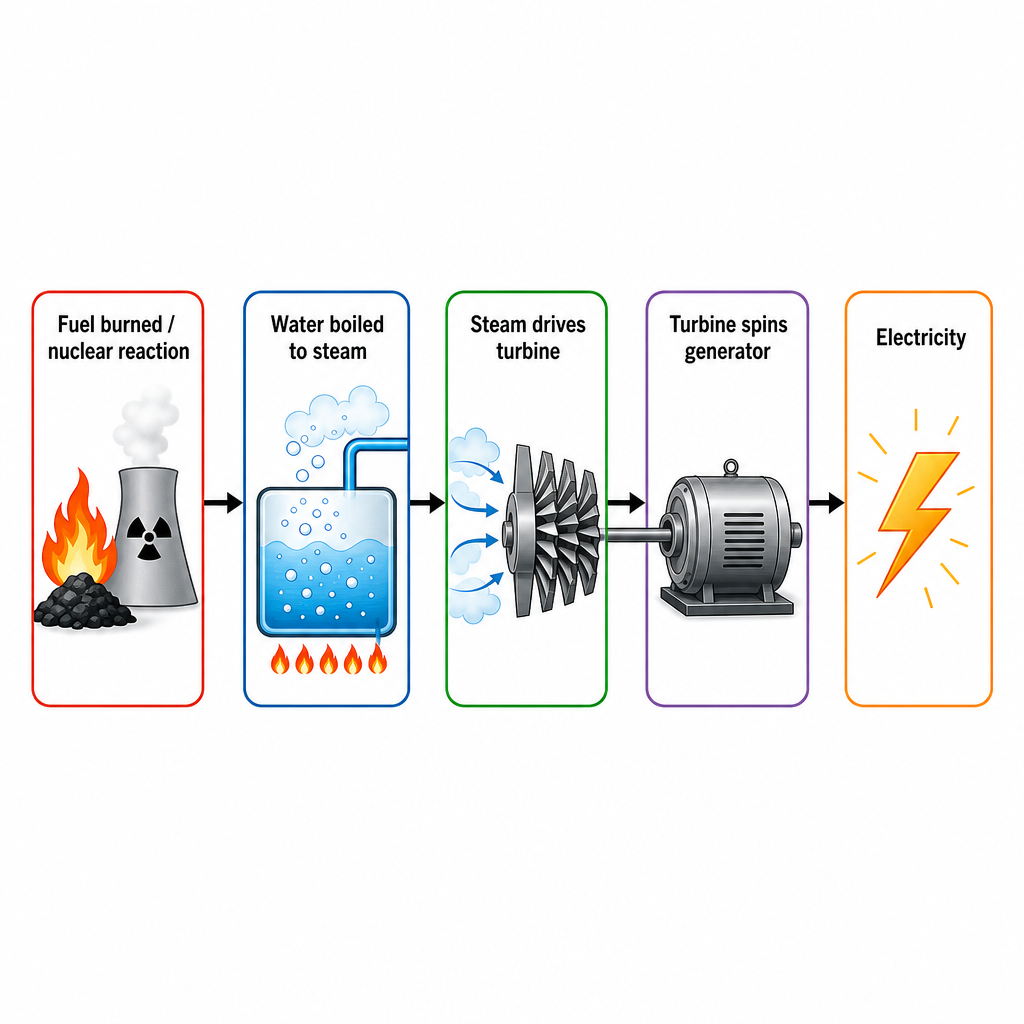
> 🔑 Key idea: Turbine spins a generator. Fossil + nuclear are non-renewable; wind/solar/hydro/tidal/geothermal/wave are renewable. Most energy traces to the Sun.
Worked Example: Choosing a Resource1.7.3
Problem A small, sunny island with no fuel deposits wants reliable daytime electricity with no air pollution. Suggest a suitable energy resource and one drawback.
Step 1 Solar (photovoltaic) suits a sunny island: no fuel needed, no air pollution, and plenty of daytime sunlight. The main drawback is that it generates nothing at night and little in cloudy weather, so it needs battery storage or a backup supply.
Power and Efficiency1.7.4
Power is the rate of transferring energy (or doing work): $P = \dfrac{\Delta E}{t} = \dfrac{W}{t}$, measured in watts ($1$ W $= 1$ J/s). A powerful motor does the same job faster. No real machine is perfect: efficiency tells you what fraction of the energy input comes out as the useful output, $\text{efficiency} = \dfrac{\text{useful energy output}}{\text{total energy input}} \times 100\%$. The rest is "wasted", usually as heat. An efficient LED bulb turns most input into light; an old filament bulb wastes most as heat.
> 🔑 Key formula: $P = \dfrac{E}{t}$ (watts). Efficiency $= \dfrac{\text{useful out}}{\text{total in}} \times 100\%$.
Worked Example: Motor Power and Efficiency1.7.4
Problem A motor does $6000$ J of useful work in $30$ s while drawing $9000$ J of electrical energy. Find its power output and its efficiency.
Step 1 Power output: $P = \dfrac{W}{t} = \dfrac{6000}{30} = 200$ W.
Step 2 Efficiency: $\dfrac{6000}{9000} \times 100\% \approx 67\%$. The other third is lost, mostly as heat in the motor.
Pressure1.8
Pressure is force spread over an area: $p = \dfrac{F}{A}$, measured in pascals ($1$ Pa $= 1$ N/m²). The same force on a smaller area gives a higher pressure, which is why a sharp drawing pin pierces a board easily and why snowshoes (large area) stop you sinking. In a liquid, pressure increases with depth: $\Delta p = \rho g\,\Delta h$, so a dam wall is built thicker at the bottom. Hydraulic systems use this to multiply forces.
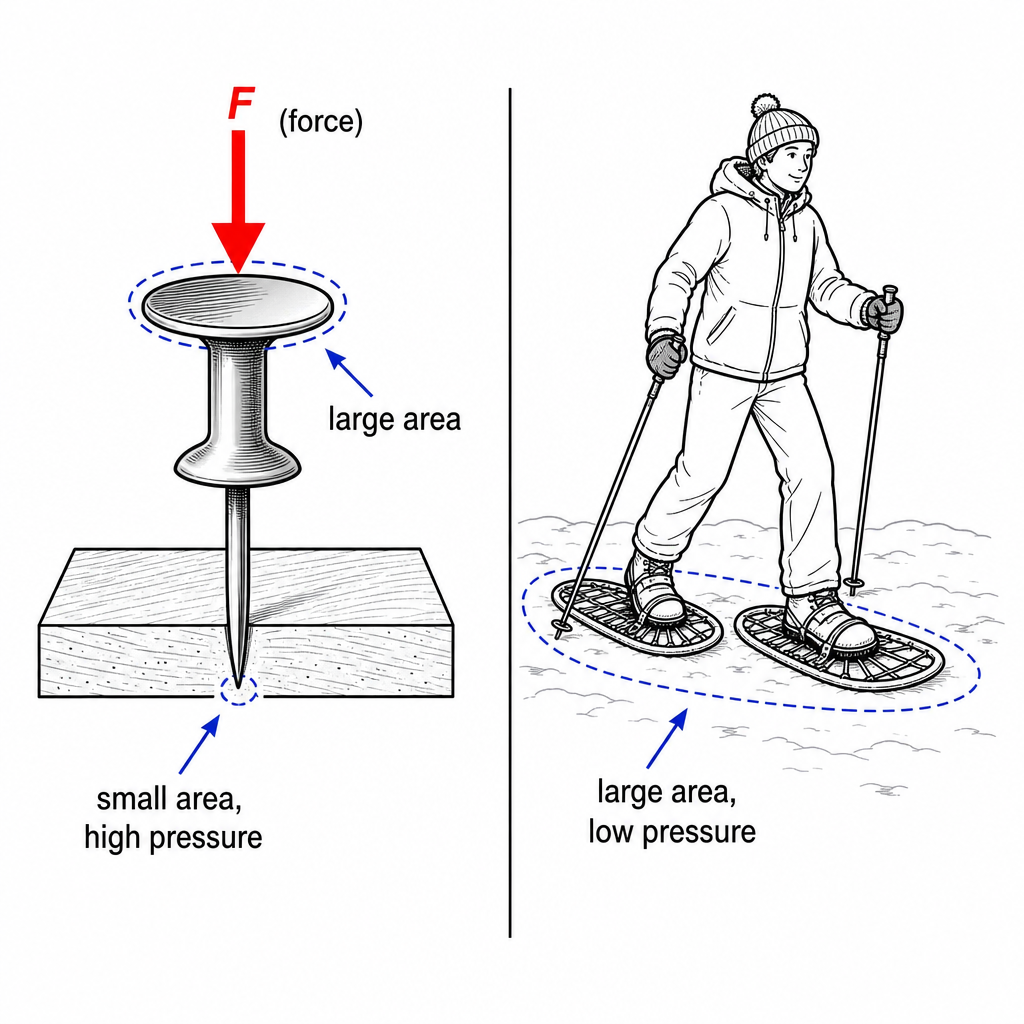
> 🔑 Key formula: $p = \dfrac{F}{A}$ (pascals). Smaller area → higher pressure. In liquids, pressure rises with depth ($\Delta p = \rho g\,\Delta h$).
Worked Example: Pressure Under a Box1.8
Problem A box pushes down with a force of $200$ N over a base area of $0.50$ m². Find the pressure it exerts on the floor.
Step 1 Apply $p = \dfrac{F}{A} = \dfrac{200}{0.50} = 400$ Pa. Stand the same box on a smaller face and the area drops, so the pressure rises, even though the weight is unchanged.
Key Points to Remember
- For thin or fast things, measure many and divide (100 sheets, 20 swings); read a meniscus at eye level.
- $\text{speed} = \dfrac{d}{t}$, $a = \dfrac{\Delta v}{t}$. On a speed–time graph the gradient is acceleration and the area underneath is distance. Free-fall $g \approx 9.8$ m/s².
- Mass (kg) is fixed everywhere; weight $W = mg$ (N) depends on the gravitational field strength $g$ ($\approx 9.8$ N/kg on Earth).
- Density $\rho = \dfrac{m}{V}$. An object floats if it is less dense than the liquid, sinks if more dense.
- Newton's second law: $F = ma$ (resultant force). Hooke's law $F = kx$ holds up to the limit of proportionality.
- Moment $= F \times d$ (perpendicular distance). Balanced: clockwise moments = anticlockwise moments.
- An object is stable with a low centre of gravity and a wide base; it topples when its weight line falls outside its base.
- Energy is conserved (transferred between stores, never destroyed): $E_k = \tfrac{1}{2}mv^2$, $\Delta E_p = mg\,\Delta h$.
- Work done $W = F \times d$ (joules) is energy transferred by a force moving through a distance.
- Power $P = \dfrac{E}{t}$ (watts) is the rate of energy transfer; efficiency $= \dfrac{\text{useful out}}{\text{total in}} \times 100\%$.
- Pressure $p = \dfrac{F}{A}$ (pascals): smaller area gives higher pressure; in a liquid pressure rises with depth.
- Energy resources: fossil fuels and nuclear are non-renewable; wind, solar, hydro, tidal, wave, geothermal, and biofuels are renewable. Most trace back to the Sun.